
Textbook Question
Economics
Marginal revenue
Suppose that the revenue from selling x washing machines is
r(x) = 20000(1 − 1/x) dollars.
c. Find the limit of r'(x) as x → ∞. How would you interpret this number?

 Verified step by step guidance
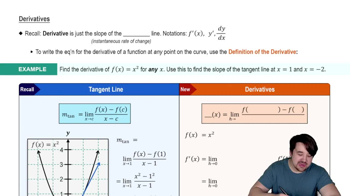
 05:44
05:44
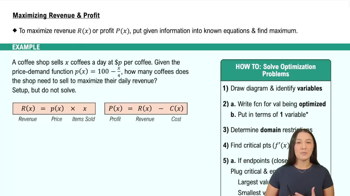 04:18
04:18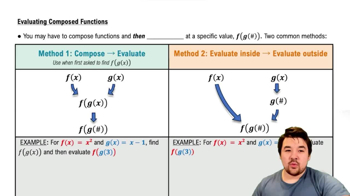 4:26
4:26Economics
Marginal revenue
Suppose that the revenue from selling x washing machines is
r(x) = 20000(1 − 1/x) dollars.
c. Find the limit of r'(x) as x → ∞. How would you interpret this number?
Economics
Marginal cost Suppose that the dollar cost of producing x washing machines is c(x) = 2000 + 100x − 0.1x².
a. Find the average cost per machine of producing the first 100 washing machines.
Economics
Marginal cost Suppose that the dollar cost of producing x washing machines is c(x) = 2000 + 100x − 0.1x².
c. Show that the marginal cost when 100 washing machines are produced is approximately the cost of producing one more washing machine after the first 100 have been made, by calculating the latter cost directly.
Using the Alternative Formula for Derivatives
Use the formula
f'(x) = lim (z → x) (f(z) − f(x)) / (z − x)
to find the derivative of the functions in Exercises 23–26.
f(x) = x² − 3x + 4
In Exercises 19–22, find the values of the derivatives.
dr/dθ |θ₌₀ if r = 2/√(4 – θ)
Additional Applications
Bacterium population
When a bactericide was added to a nutrient broth in which bacteria were growing, the bacterium population continued to grow for a while, but then stopped growing and began to decline. The size of the population at time t (hours) was b = 10⁶ + 10⁴t − 10³t². Find the growth rates at
a. t = 0 hours.
b. t = 5 hours.
c. t = 10 hours.