Ch. 3 - Derivatives
Hass - Thomas' Calculus 15th Edition
Hass15th EditionThomas' CalculusISBN: 9780137616077Not the one you use?Change textbook
Chapter 3, Problem 3.9.37

Differential Estimates of Change


In Exercises 35–40, write a differential formula that estimates the given change in volume or surface area.


The change in the surface area S = 6x² of a cube when the edge lengths change from x₀ to x₀ + dx

Verified step by step guidance
1
Identify the formula for the surface area of a cube, which is given by \( S = 6x^2 \), where \( x \) is the length of an edge of the cube.
To estimate the change in surface area, we use the concept of differentials. The differential \( dS \) represents the approximate change in the surface area when the edge length changes by a small amount \( dx \).
Calculate the derivative of the surface area with respect to \( x \). This is \( \frac{dS}{dx} = \frac{d}{dx}(6x^2) \).
Compute the derivative: \( \frac{dS}{dx} = 12x \). This derivative tells us how the surface area changes with respect to a small change in \( x \).
The differential formula for the change in surface area is \( dS = 12x \, dx \). This formula estimates the change in surface area \( dS \) when the edge length changes by \( dx \).

Verified video answer for a similar problem:

This video solution was recommended by our tutors as helpful for the problem above.
Video duration:
2m
Was this helpful?

Key Concepts

Here are the essential concepts you must grasp in order to answer the question correctly.

Differential Calculus

Differential calculus focuses on the concept of the derivative, which represents the rate of change of a function. In this context, it helps estimate how a small change in one variable (like the edge length of a cube) affects another variable (such as surface area). Understanding how to compute and apply derivatives is crucial for solving problems involving differential estimates.
Recommended video:
06:11
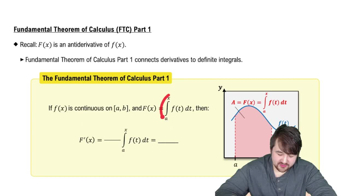
Fundamental Theorem of Calculus Part 1

Surface Area of a Cube

The surface area of a cube is calculated using the formula S = 6x², where x is the length of an edge. This formula is essential for determining how changes in the edge length affect the surface area. Recognizing this relationship allows us to apply differential calculus to estimate changes in surface area when the edge length changes slightly.
Recommended video:
09:07
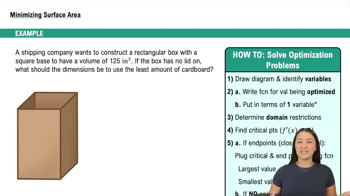
Example 1: Minimizing Surface Area

Differential Formula

A differential formula provides an approximation of how a function changes as its input changes. For a function S = 6x², the differential dS can be expressed as dS = d(6x²) = 12x dx, where dx is a small change in x. This formula is used to estimate the change in surface area when the edge length of the cube changes by a small amount dx.
Recommended video:
05:53
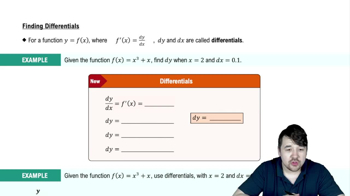
Finding Differentials