Ch. 3 - Derivatives
Hass - Thomas' Calculus 15th Edition
Hass15th EditionThomas' CalculusISBN: 9780137616077Not the one you use?Change textbook
Chapter 3, Problem 3.5.29

Derivatives


In Exercises 27–32, find dp/dq.


p = (sin q + cos q) / cos q

Verified step by step guidance
1
Step 1: Start by identifying the function p in terms of q. Here, p is given as \( p = \frac{\sin q + \cos q}{\cos q} \).
Step 2: Simplify the expression for p. Divide each term in the numerator by the denominator: \( p = \frac{\sin q}{\cos q} + \frac{\cos q}{\cos q} \). This simplifies to \( p = \tan q + 1 \).
Step 3: Differentiate p with respect to q. The derivative of \( \tan q \) with respect to q is \( \sec^2 q \), and the derivative of a constant (1) is 0.
Step 4: Combine the derivatives to find \( \frac{dp}{dq} \). Since \( p = \tan q + 1 \), \( \frac{dp}{dq} = \sec^2 q + 0 \).
Step 5: Conclude that the derivative of p with respect to q is \( \frac{dp}{dq} = \sec^2 q \).

Verified video answer for a similar problem:

This video solution was recommended by our tutors as helpful for the problem above.
Video duration:
2m
Was this helpful?

Key Concepts

Here are the essential concepts you must grasp in order to answer the question correctly.

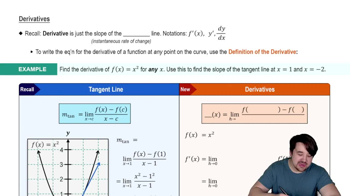
Derivatives

A derivative represents the rate at which a function changes as its input changes. It is a fundamental concept in calculus that measures how a function's output value varies with respect to changes in its input variable. The derivative of a function can be interpreted as the slope of the tangent line to the function's graph at a given point.
Recommended video:
05:44
Derivatives

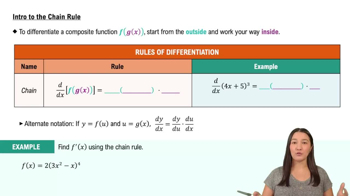
Chain Rule

The chain rule is a formula for computing the derivative of a composite function. If a function is composed of two or more functions, the chain rule allows us to differentiate it by multiplying the derivative of the outer function by the derivative of the inner function. This is essential when dealing with functions that are expressed in terms of other functions, as in the case of p = (sin q + cos q) / cos q.
Recommended video:
05:02
Intro to the Chain Rule

Trigonometric Derivatives

Trigonometric derivatives involve the differentiation of functions that include trigonometric functions such as sine and cosine. The derivatives of these functions are well-defined: the derivative of sin(q) is cos(q), and the derivative of cos(q) is -sin(q). Understanding these derivatives is crucial for solving problems involving trigonometric functions, especially when applying the quotient rule in this context.
Recommended video:
06:35
Derivatives of Other Inverse Trigonometric Functions