Ch. 3 - Derivatives
Hass - Thomas' Calculus 15th Edition
Hass15th EditionThomas' CalculusISBN: 9780137616077Not the one you use?Change textbook
Chapter 3, Problem 3.9.21

Derivatives in Differential Form


In Exercises 17–28, find dy.


2y³/² + xy − x = 0

Verified step by step guidance
1
First, identify the given equation: 2y^(3/2) + xy - x = 0. We need to find dy, which involves differentiating the equation with respect to x.
Apply implicit differentiation to each term of the equation with respect to x. Remember that y is a function of x, so when differentiating terms involving y, use the chain rule.
Differentiate the first term, 2y^(3/2), with respect to x. Using the chain rule, this becomes (3/2) * 2 * y^(1/2) * dy/dx.
Differentiate the second term, xy, with respect to x. This requires the product rule: differentiate x to get 1, and differentiate y to get dy/dx, resulting in y + x * dy/dx.
Differentiate the third term, -x, with respect to x, which simply becomes -1. Combine all differentiated terms and solve for dy/dx to find dy.

Verified video answer for a similar problem:

This video solution was recommended by our tutors as helpful for the problem above.
Video duration:
3m
Was this helpful?

Key Concepts

Here are the essential concepts you must grasp in order to answer the question correctly.

Implicit Differentiation

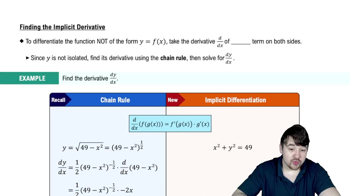
Implicit differentiation is a technique used to find the derivative of a function when it is not explicitly solved for one variable in terms of another. In equations where y is not isolated, we differentiate both sides with respect to x, treating y as a function of x, and apply the chain rule to terms involving y.
Recommended video:
05:14
Finding The Implicit Derivative

Chain Rule

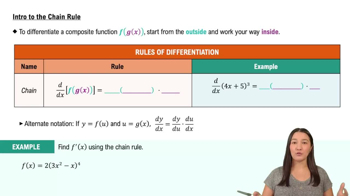
The chain rule is a fundamental principle in calculus used to differentiate composite functions. It states that the derivative of a composite function is the derivative of the outer function evaluated at the inner function, multiplied by the derivative of the inner function. This rule is crucial when differentiating terms like y^(3/2) with respect to x, where y is a function of x.
Recommended video:
05:02
Intro to the Chain Rule

Solving for dy

After applying implicit differentiation, the goal is to solve for dy/dx, which represents the derivative of y with respect to x. This involves isolating dy/dx on one side of the equation, often requiring algebraic manipulation to combine like terms and factor out dy/dx, ultimately expressing it in terms of x and y.
Recommended video:
5:02
Solving Logarithmic Equations