Ch. 3 - Derivatives
Hass - Thomas' Calculus 15th Edition
Hass15th EditionThomas' CalculusISBN: 9780137616077Not the one you use?Change textbook
Chapter 3, Problem 3.6.5

Derivative Calculations


In Exercises 1–8, given y = f(u) and u = g(x), find dy/dx = f'(g(x)) g'(x).


y = √u, u = sin x

Verified step by step guidance
1
First, identify the functions involved: y = √u and u = sin(x). We need to find dy/dx using the chain rule.
The chain rule states that dy/dx = f'(u) * g'(x), where f(u) = √u and g(x) = sin(x).
Calculate f'(u): Since y = √u, f(u) = u^(1/2). The derivative f'(u) with respect to u is (1/2)u^(-1/2).
Calculate g'(x): Since u = sin(x), the derivative g'(x) with respect to x is cos(x).
Combine the derivatives using the chain rule: dy/dx = f'(u) * g'(x) = (1/2)u^(-1/2) * cos(x). Substitute u = sin(x) into the expression to get dy/dx = (1/2)(sin(x))^(-1/2) * cos(x).

Verified video answer for a similar problem:

This video solution was recommended by our tutors as helpful for the problem above.
Video duration:
2m
Was this helpful?

Key Concepts

Here are the essential concepts you must grasp in order to answer the question correctly.

Chain Rule

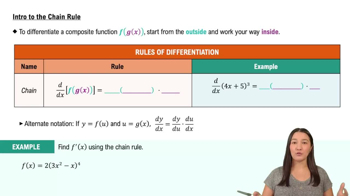
The chain rule is a fundamental theorem in calculus used to differentiate composite functions. It states that if you have a function y = f(u) and u = g(x), then the derivative dy/dx is found by multiplying the derivative of f with respect to u, f'(u), by the derivative of u with respect to x, g'(x). This allows us to differentiate complex functions by breaking them down into simpler parts.
Recommended video:
05:02
Intro to the Chain Rule

Derivative of Square Root Function

To differentiate a square root function, y = √u, we use the power rule. The square root can be expressed as u^(1/2), and its derivative is (1/2)u^(-1/2) or 1/(2√u). This derivative is crucial when applying the chain rule to composite functions involving square roots, as it provides the rate of change of the square root function with respect to its variable.
Recommended video:
01:32
Derivatives of Other Trig Functions Example 1

Derivative of Sine Function

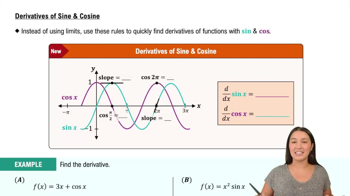
The derivative of the sine function, u = sin x, is cos x. This is a basic derivative that is essential when applying the chain rule to functions involving trigonometric components. Understanding this derivative allows us to determine how the sine function changes with respect to x, which is necessary for calculating the overall derivative of composite functions like y = √u where u = sin x.
Recommended video:
03:53
Derivatives of Sine & Cosine