Ch. 3 - Derivatives
Hass - Thomas' Calculus 15th Edition
Hass15th EditionThomas' CalculusISBN: 9780137616077Not the one you use?Change textbook
Chapter 3, Problem 3.6.6

Derivative Calculations


In Exercises 1–8, given y = f(u) and u = g(x), find dy/dx = f'(g(x)) g'(x).


y = sin u, u = x − cos x

Verified step by step guidance
1
First, identify the functions involved: y = sin(u) and u = x - cos(x). We need to find dy/dx using the chain rule.
Apply the chain rule: dy/dx = (dy/du) * (du/dx). This means we need to find the derivative of y with respect to u and the derivative of u with respect to x.
Calculate dy/du: Since y = sin(u), the derivative dy/du is cos(u).
Calculate du/dx: For u = x - cos(x), the derivative du/dx is 1 + sin(x), because the derivative of x is 1 and the derivative of -cos(x) is sin(x).
Combine the derivatives using the chain rule: dy/dx = cos(u) * (1 + sin(x)). Substitute u = x - cos(x) into the expression to get dy/dx = cos(x - cos(x)) * (1 + sin(x)).

Verified video answer for a similar problem:

This video solution was recommended by our tutors as helpful for the problem above.
Video duration:
4m
Was this helpful?

Key Concepts

Here are the essential concepts you must grasp in order to answer the question correctly.

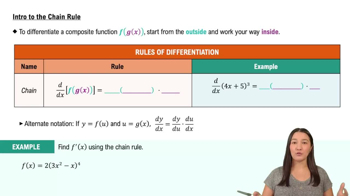
Chain Rule

The chain rule is a fundamental differentiation technique used when dealing with composite functions. It states that the derivative of a composite function y = f(g(x)) is found by multiplying the derivative of the outer function f with respect to its inner function g, by the derivative of the inner function g with respect to x. This is essential for calculating dy/dx when y and u are functions of x.
Recommended video:
05:02
Intro to the Chain Rule

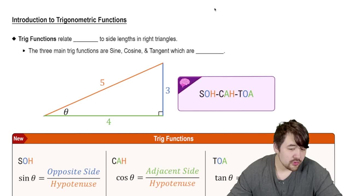
Derivative of Trigonometric Functions

Understanding the derivatives of trigonometric functions is crucial for solving problems involving these functions. For instance, the derivative of sin(u) with respect to u is cos(u). This knowledge is necessary to apply the chain rule effectively when differentiating y = sin(u) in terms of x, where u is a function of x.
Recommended video:
6:04
Introduction to Trigonometric Functions

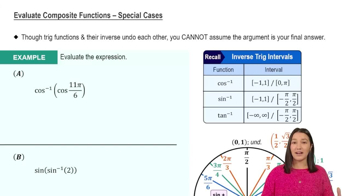
Differentiation of Composite Functions

Differentiation of composite functions involves applying the chain rule to find the derivative of a function that is composed of other functions. In the given problem, y = sin(u) and u = x - cos(x) are composite functions, requiring the application of the chain rule to find dy/dx by differentiating each component function separately and then combining the results.
Recommended video:
3:48
Evaluate Composite Functions - Special Cases