Ch. 3 - Derivatives
Hass - Thomas' Calculus 15th Edition
Hass15th EditionThomas' CalculusISBN: 9780137616077Not the one you use?Change textbook
Chapter 3, Problem 3.2.31b

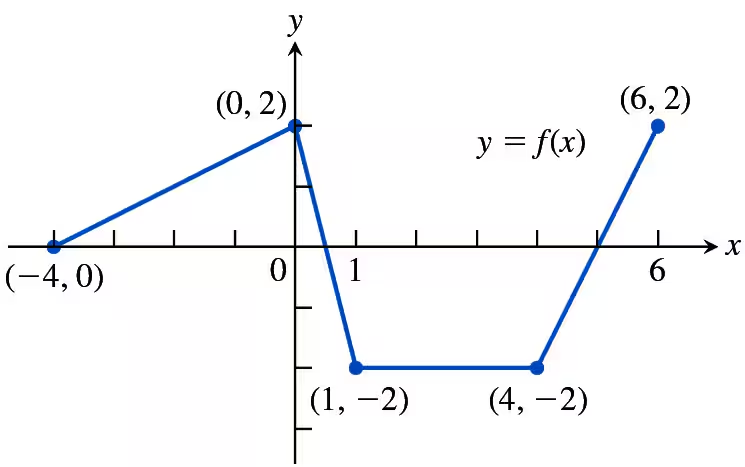
Consider the function f graphed here. The domain of f is the interval [−4, 6] and its graph is made of line segments joined end to end.


<IMAGE>


b. Graph the derivative of f. The graph should show a step function.

Verified step by step guidance
1
Step 1: Analyze the graph of f(x). The function is piecewise linear, composed of line segments joined end to end. The domain is [−4, 6], and the graph has vertices at (−4, 0), (0, 2), (1, −2), (4, −2), and (6, 2).
Step 2: Recall that the derivative of a function represents the slope of the tangent line at any given point. For a piecewise linear function, the derivative is constant within each segment since the slope does not change.
Step 3: Calculate the slope of each segment: - From (−4, 0) to (0, 2), the slope is \( \frac{2 - 0}{0 - (-4)} = \frac{2}{4} = \frac{1}{2} \). - From (0, 2) to (1, −2), the slope is \( \frac{-2 - 2}{1 - 0} = \frac{-4}{1} = -4 \). - From (1, −2) to (4, −2), the slope is \( \frac{-2 - (-2)}{4 - 1} = \frac{0}{3} = 0 \). - From (4, −2) to (6, 2), the slope is \( \frac{2 - (-2)}{6 - 4} = \frac{4}{2} = 2 \).
Step 4: Represent the derivative as a step function. The derivative is constant within each interval: - On [−4, 0], the derivative is \( \frac{1}{2} \). - On [0, 1], the derivative is −4. - On [1, 4], the derivative is 0. - On [4, 6], the derivative is 2.
Step 5: Sketch the graph of the derivative. The graph will be a step function with constant values: - A horizontal line at \( \frac{1}{2} \) from x = −4 to x = 0. - A horizontal line at −4 from x = 0 to x = 1. - A horizontal line at 0 from x = 1 to x = 4. - A horizontal line at 2 from x = 4 to x = 6.

Verified video answer for a similar problem:

This video solution was recommended by our tutors as helpful for the problem above.
Video duration:
4m
Was this helpful?

Key Concepts

Here are the essential concepts you must grasp in order to answer the question correctly.

Derivative of a Function

The derivative of a function at a point measures the rate at which the function value changes as its input changes. For a piecewise linear function, the derivative is constant on each segment, representing the slope of the line. In this graph, the derivative will be a step function, indicating constant slopes between the given points.
Recommended video:
06:30
Derivatives of Other Trig Functions

Piecewise Linear Functions

A piecewise linear function is composed of straight line segments. Each segment has a constant slope, which is the derivative of the function over that interval. Understanding the slopes of these segments is crucial for graphing the derivative, as each segment's slope corresponds to a constant value in the derivative's graph.
Recommended video:
05:36
Piecewise Functions

Step Functions

A step function is a piecewise function that jumps from one constant value to another at specific points. When graphing the derivative of a piecewise linear function, the result is a step function, where each step corresponds to the slope of a segment in the original function. This graph will have horizontal lines at the slope values, changing at the endpoints of each segment.
Recommended video:
4:26
Evaluating Composed Functions