Ch. 3 - Derivatives
Hass - Thomas' Calculus 15th Edition
Hass15th EditionThomas' CalculusISBN: 9780137616077Not the one you use?Change textbook
Chapter 3, Problem 3.8.3

Assume that y = 5x and dx/dt = 2. Find dy/dt

Verified step by step guidance
1
Start by identifying the given information: y = 5x and dx/dt = 2. We need to find dy/dt.
Recognize that y is a function of x, and both y and x are functions of time t. This implies we need to use the chain rule for differentiation.
Apply the chain rule: The derivative of y with respect to t, dy/dt, can be found using dy/dt = (dy/dx) * (dx/dt).
Differentiate y = 5x with respect to x to find dy/dx. Since y = 5x, dy/dx = 5.
Substitute dy/dx = 5 and dx/dt = 2 into the chain rule formula: dy/dt = 5 * 2.

Verified video answer for a similar problem:

This video solution was recommended by our tutors as helpful for the problem above.
Video duration:
2m
Was this helpful?

Key Concepts

Here are the essential concepts you must grasp in order to answer the question correctly.

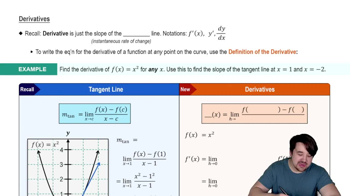
Derivative

A derivative represents the rate at which a function is changing at any given point and is a fundamental tool in calculus. In this context, dy/dt and dx/dt are derivatives that describe how y and x change with respect to time t. Understanding derivatives is crucial for solving problems involving rates of change.
Recommended video:
05:44
Derivatives

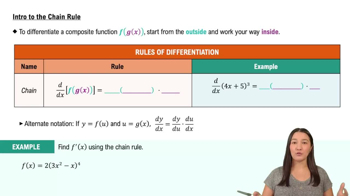
Chain Rule

The chain rule is a formula for computing the derivative of the composition of two or more functions. It is essential here because y is a function of x, which is itself a function of t. The chain rule allows us to find dy/dt by multiplying the derivative of y with respect to x (dy/dx) by the derivative of x with respect to t (dx/dt).
Recommended video:
05:02
Intro to the Chain Rule

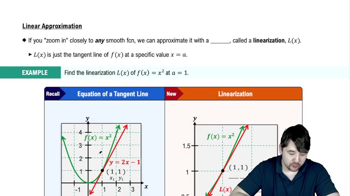
Linear Functions

A linear function is a function of the form y = mx + b, where m and b are constants. In this problem, y = 5x is a linear function with a slope of 5. Understanding linear functions helps in recognizing that the derivative dy/dx is constant, which simplifies the application of the chain rule to find dy/dt.
Recommended video:
07:17
Linearization