Ch. 3 - Derivatives
Hass - Thomas' Calculus 15th Edition
Hass15th EditionThomas' CalculusISBN: 9780137616077Not the one you use?Change textbook
Chapter 3, Problem 3.8.19b

Area The area A of a triangle with sides of lengths a and b enclosing an angle of measure θ is
A = (1/2) ab sinθ.


b. How is dA/dt related to dθ/dt and da/dt if only b is constant?

Verified step by step guidance
1
Start by identifying the given formula for the area of the triangle: A = (1/2) * a * b * sin(θ). Since b is constant, it will not change with time.
To find how dA/dt is related to dθ/dt and da/dt, apply the chain rule for differentiation with respect to time t. This involves differentiating A with respect to a, θ, and t.
Differentiate A with respect to a: ∂A/∂a = (1/2) * b * sin(θ). Then, apply the chain rule: dA/dt = (∂A/∂a) * (da/dt).
Differentiate A with respect to θ: ∂A/∂θ = (1/2) * a * b * cos(θ). Then, apply the chain rule: dA/dt = (∂A/∂θ) * (dθ/dt).
Combine the results from the previous steps to express dA/dt in terms of da/dt and dθ/dt: dA/dt = (1/2) * b * sin(θ) * (da/dt) + (1/2) * a * b * cos(θ) * (dθ/dt).

Verified video answer for a similar problem:

This video solution was recommended by our tutors as helpful for the problem above.
Video duration:
3m
Was this helpful?

Key Concepts

Here are the essential concepts you must grasp in order to answer the question correctly.

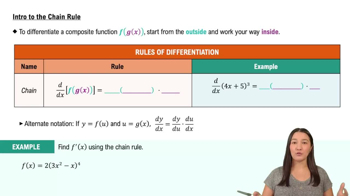
Chain Rule

The chain rule is a fundamental concept in calculus used to differentiate composite functions. It states that if a variable z depends on y, which in turn depends on x, then the derivative of z with respect to x is the product of the derivative of z with respect to y and the derivative of y with respect to x. This rule is essential for finding dA/dt when A is a function of multiple variables that change over time.
Recommended video:
05:02
Intro to the Chain Rule

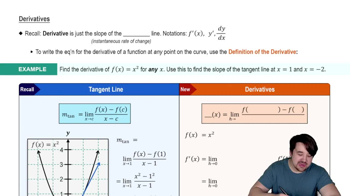
Partial Derivatives

Partial derivatives are used to find the rate of change of a multivariable function with respect to one variable while keeping other variables constant. In the context of the area of a triangle, partial derivatives help determine how changes in angle θ and side length a affect the area A, especially when side b is constant. This concept is crucial for understanding how dA/dt relates to dθ/dt and da/dt.
Recommended video:
05:44
Derivatives

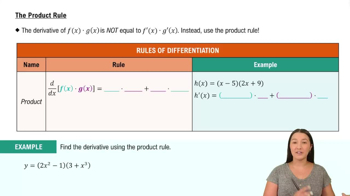
Product Rule

The product rule is a technique used to differentiate expressions where two functions are multiplied together. It states that the derivative of a product of two functions is the derivative of the first function times the second function plus the first function times the derivative of the second function. This rule is applied when differentiating the area formula A = (1/2)ab sinθ with respect to time, considering a and θ as functions of time.
Recommended video:
05:18
The Product Rule
Related Practice
Textbook Question

Computer Explorations


Use a CAS to perform the following steps in Exercises 55–62.


b. Using implicit differentiation, find a formula for the derivative dy/dx and evaluate it at the given point P.


2y² + (xy)¹/³ = x² + 2, P(1,1)

Textbook Question

The radius r of a circle is measured with an error of at most 2%. What is the maximum corresponding percentage error in computing the circle’s


b. area?

Textbook Question

Temperatures in Fairbanks, Alaska The graph in the accompanying figure shows the average Fahrenheit temperature in Fairbanks, Alaska, during a typical 365-day year. The equation that approximates the temperature on day x is


y = 37 sin[(2π/365)(x − 101)] + 25


and is graphed in the accompanying figure.


b. About how many degrees per day is the temperature increasing when it is increasing at its fastest?


" style="max-width: 100%; white-space-collapse: preserve;" width="420">

1
views
Textbook Question

Computer Explorations


Use a CAS to perform the following steps in Exercises 55–62.


b. Using implicit differentiation, find a formula for the derivative dy/dx and evaluate it at the given point P.


x√(1 + 2y) + y = x², P(1,0)

Textbook Question

Diagonals If x, y, and z are lengths of the edges of a rectangular box, then the common length of the box’s diagonals is s = √(x² + y² + z²).

b. How is ds/dt related to dy/dt and dz/dt if x is constant?

Textbook Question

Generalizing the Product Rule The Derivative Product Rule gives the formula


d/dx (uv) = u (dv/dx) + (du/dx) v


for the derivative of the product uv of two differentiable functions of x.


b. What is the formula for the derivative of the product u₁u₂u₃u₄ of four differentiable functions of x?