
Ch. 3 - Derivatives
Hass - Thomas' Calculus 15th Edition
Hass15th EditionThomas' CalculusISBN: 9780137616077Not the one you use?Change textbook
Chapter 3, Problem 54

a. Find an equation for the line that is tangent to the curve y = x³ − 6x² + 5x at the origin.
[Technology Exercise] b. Graph the curve and tangent line together. The tangent line intersects the curve at another point. Use Zoom and Trace to estimate the point’s coordinates.
[Technology Exercise] c. Confirm your estimates of the coordinates of the second intersection point by solving the equations for the curve and tangent line simultaneously.

Verified step by step guidance
1
To find the equation of the tangent line at the origin, we first need to determine the derivative of the curve y = x³ − 6x² + 5x. The derivative, y', represents the slope of the tangent line at any point x.
Calculate the derivative of y = x³ − 6x² + 5x. Using the power rule, the derivative y' = 3x² - 12x + 5.
Evaluate the derivative at the origin (x = 0) to find the slope of the tangent line at that point. Substitute x = 0 into y' to get the slope m = 3(0)² - 12(0) + 5 = 5.
The equation of the tangent line can be written in the point-slope form: y - y₁ = m(x - x₁). Since the tangent line is at the origin (0,0), the equation becomes y - 0 = 5(x - 0), or y = 5x.
To find the second intersection point, set the equation of the curve equal to the equation of the tangent line: x³ − 6x² + 5x = 5x. Simplify and solve the resulting equation x³ − 6x² = 0 to find the x-coordinates of the intersection points.

Verified video answer for a similar problem:

This video solution was recommended by our tutors as helpful for the problem above.
Video duration:
4m
Was this helpful?

Key Concepts

Here are the essential concepts you must grasp in order to answer the question correctly.

Tangent Line

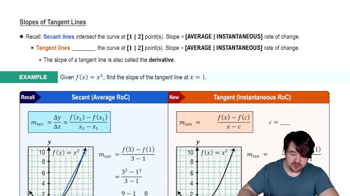
A tangent line to a curve at a given point is a straight line that touches the curve at that point without crossing it. The slope of the tangent line is equal to the derivative of the function at that point. To find the equation of the tangent line, one typically uses the point-slope form of a line, which requires both the slope and a point on the line.
Recommended video:
05:13
Slopes of Tangent Lines

Derivative

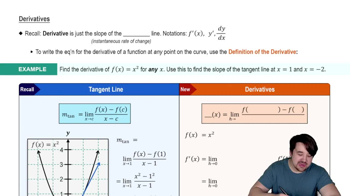
The derivative of a function measures how the function's output value changes as its input value changes. It is a fundamental concept in calculus that provides the slope of the tangent line at any point on the curve. For the function y = x³ − 6x² + 5x, finding the derivative will allow us to determine the slope at the origin, which is essential for constructing the tangent line.
Recommended video:
05:44
Derivatives

Simultaneous Equations

Simultaneous equations are a set of equations with multiple variables that are solved together to find common solutions. In this context, solving the equations for the curve and the tangent line simultaneously will help identify the points where they intersect. This is crucial for confirming the coordinates of the second intersection point, which can be estimated graphically.
Recommended video:
5:02
Solving Logarithmic Equations
Related Practice
Textbook Question

When the length L of a clock pendulum is held constant by controlling its temperature, the pendulum’s period T depends on the acceleration of gravity g. The period will therefore vary slightly as the clock is moved from place to place on Earth’s surface, depending on the change in g. By keeping track of ΔT, we can estimate the variation in g from the equation T = 2π(L/g)¹/² that relates T, g, and L.


a. With L held constant and g as the independent variable, calculate dT and use it to answer parts (b) and (c).

Textbook Question

Find all points (x, y) on the graph of y = x/(x − 2) with tangent lines perpendicular to the line y = 2x + 3.

Textbook Question

A weight is attached to a spring and reaches its equilibrium position (x = 0). It is then set in motion resulting in a displacement of x = 10 cos t, where x is measured in centimeters and t is measured in seconds. See the accompanying figure.

Find the spring’s displacement when t = 0, t = π/3, and t = 3π/4.

1
views
Textbook Question

When the length L of a clock pendulum is held constant by controlling its temperature, the pendulum’s period T depends on the acceleration of gravity g. The period will therefore vary slightly as the clock is moved from place to place on Earth’s surface, depending on the change in g. By keeping track of ΔT, we can estimate the variation in g from the equation T = 2π(L/g)¹/² that relates T, g, and L.


b. If g increases, will T increase or decrease? Will a pendulum clock speed up or slow down? Explain.

Textbook Question

In Exercises 51 and 52, find dp/dq.

q = (5p² + 2p)⁻³/²

Textbook Question

Assume that functions f and g are differentiable with f(1) = 2, f'(1) = −3, g(1) = 4, and g'(1) = −2. Find the equation of the line tangent to the graph of F(x) = f(x)g(x) at x = 1.