Ch. 2 - Limits and Continuity
Hass - Thomas' Calculus 15th Edition
Hass15th EditionThomas' CalculusISBN: 9780137616077Not the one you use?Change textbook
Chapter 2, Problem 76

Theory and Examples


Suppose that g(x) ≤ f(x) ≤ h(x) for all x≠2 and suppose that lim x→2 g(x) = lim x→2 h(x) = −5. Can we conclude anything about the values of f, g, and h at x = 2? Could f(2) = 0? Could limx→2 f(x)=0? Give reasons for your answers.

Verified step by step guidance
1
First, let's understand the concept of the Squeeze Theorem, which is applicable here. The Squeeze Theorem states that if g(x) ≤ f(x) ≤ h(x) for all x in some interval around a point (except possibly at the point itself), and if the limits of g(x) and h(x) as x approaches that point are equal, then the limit of f(x) as x approaches that point is also equal to that common limit.
Given that g(x) ≤ f(x) ≤ h(x) for all x ≠ 2 and both lim x→2 g(x) = −5 and lim x→2 h(x) = −5, by the Squeeze Theorem, we can conclude that lim x→2 f(x) = −5.
Now, let's consider the value of f(2). The Squeeze Theorem does not provide information about the value of f at x = 2 itself; it only concerns the behavior of f(x) as x approaches 2. Therefore, f(2) could be any real number, including 0.
Regarding whether lim x→2 f(x) could be 0, based on the Squeeze Theorem, we have already established that lim x→2 f(x) = −5. Therefore, lim x→2 f(x) cannot be 0.
In summary, while the limit of f(x) as x approaches 2 is −5, the actual value of f at x = 2 is not determined by the Squeeze Theorem and could be any real number, including 0.

Verified video answer for a similar problem:

This video solution was recommended by our tutors as helpful for the problem above.
Video duration:
5m
Was this helpful?

Key Concepts

Here are the essential concepts you must grasp in order to answer the question correctly.

Squeeze Theorem

The Squeeze Theorem states that if a function f(x) is 'squeezed' between two other functions g(x) and h(x) that both approach the same limit L as x approaches a point, then f(x) must also approach L at that point. In this case, since g(x) and h(x) both approach -5 as x approaches 2, the theorem suggests that f(x) must also approach -5 as x approaches 2.
Recommended video:
06:11
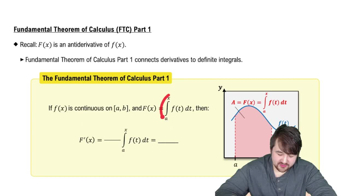
Fundamental Theorem of Calculus Part 1

Limits

A limit describes the behavior of a function as its input approaches a certain value. In this context, we are interested in the limit of f(x) as x approaches 2. Understanding limits is crucial for determining the continuity and behavior of functions at specific points, especially when direct substitution is not possible.
Recommended video:
05:50
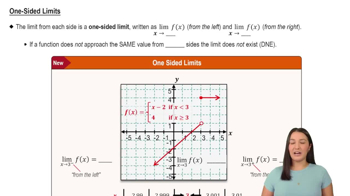
One-Sided Limits

Continuity

A function is continuous at a point if the limit of the function as it approaches that point equals the function's value at that point. In this scenario, even if f(2) could be 0, the limit of f(x) as x approaches 2 must still equal -5, indicating that f(x) cannot be continuous at x = 2 if it takes the value 0 there.
Recommended video:
05:34
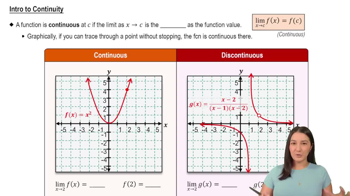
Intro to Continuity