
Ch. 2 - Limits and Continuity
Hass - Thomas' Calculus 15th Edition
Hass15th EditionThomas' CalculusISBN: 9780137616077Not the one you use?Change textbook
Chapter 2, Problem 25b

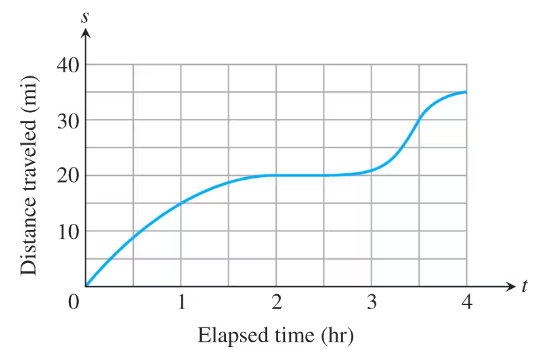
The accompanying graph shows the total distance s traveled by a bicyclist after t hours.
img
b. Estimate the bicyclist’s instantaneous speed at the times t=1/2, t=2, and t=3.

Verified step by step guidance
1
To estimate the bicyclist's instantaneous speed at a given time, we need to find the derivative of the distance function s with respect to time t, which represents the speed. This is done by calculating the slope of the tangent line to the curve at the specified time.
For t = 1/2, identify the point on the graph where t = 1/2 and draw a tangent line at this point. Estimate the slope of this tangent line by choosing two points on the tangent line and using the formula for slope: \( \text{slope} = \frac{\Delta s}{\Delta t} \).
Repeat the process for t = 2. Locate the point on the graph where t = 2, draw the tangent line, and estimate its slope using two points on the tangent line.
Similarly, for t = 3, find the point on the graph where t = 3, draw the tangent line, and estimate the slope using two points on the tangent line.
The estimated slopes at t = 1/2, t = 2, and t = 3 will give you the bicyclist's instantaneous speeds at these times. Remember, the slope of the tangent line at a point on the graph of a function is the derivative of the function at that point, which represents the instantaneous rate of change.

Verified video answer for a similar problem:

This video solution was recommended by our tutors as helpful for the problem above.
Video duration:
2m
Was this helpful?

Key Concepts

Here are the essential concepts you must grasp in order to answer the question correctly.

Instantaneous Speed

Instantaneous speed refers to the speed of an object at a specific moment in time. In calculus, it is determined by finding the derivative of the position function with respect to time. This derivative gives the rate of change of distance with respect to time, allowing us to calculate how fast the bicyclist is moving at particular instances.
Recommended video:
06:29
Derivatives Applied To Velocity

Derivative

The derivative is a fundamental concept in calculus that measures how a function changes as its input changes. It represents the slope of the tangent line to the graph of the function at a given point. In the context of the bicyclist's distance function, the derivative at a specific time gives the instantaneous speed at that moment.
Recommended video:
05:44
Derivatives

Graph Interpretation

Interpreting graphs is crucial in calculus as it allows us to visualize relationships between variables. In this case, the graph of total distance versus time helps us understand how the bicyclist's speed changes over time. By analyzing the slope of the graph at specific points, we can estimate the instantaneous speed at those times.
Recommended video:
06:15
Graphing The Derivative
Related Practice
Textbook Question

[Technology Exercise] Let f(t) = 1/t for t≠0.


a. Find the average rate of change of f with respect to t over the intervals (i) from t=2 to t=3, and (ii) from t=2 to t=T.


b. Make a table of values of the average rate of change of f with respect to t over the interval [2,T], for some values of T approaching 2, say T = 2.1, 2.01, 2.001, 2.0001, 2.00001, and 2.000001.


c. What does your table indicate is the rate of change of f with respect to t at t=2?

Textbook Question

[Technology Exercise] Roots


Let ƒ(𝓍) = 𝓍³ ―𝓍― 1.


b. Solve the equation ƒ(𝓍) = 0 graphically with an error of magnitude at most 10⁻⁸ .

Textbook Question

Finding Limits

In Exercises 9–24, find the limit or explain why it does not exist.


lim x →π cos² (x― tan x)

Textbook Question

The accompanying graph shows the total amount of gasoline A in the gas tank of an automobile after it has been driven for t days.

c. Estimate the maximum rate of gasoline consumption and the specific time at which it occurs.

Textbook Question

Finding Deltas Algebraically


Each of Exercises 15–30 gives a function f(x) and numbers L, c, and ε>0. In each case, find the largest open interval about c on which the inequality |f(x)−L| <ε holds. Then give a value for δ>0 such that for all x satisfying 0 < |x−c| < δ, the inequality |f(x)−L| < ε holds.


f(x) = mx, m > 0, L = 2m, c = 2, ε = 0.03

Textbook Question

Finding Limits


In Exercises 9–24, find the limit or explain why it does not exist.


lim x →π sin (x/2 + sin x)