Ch. 2 - Limits and Continuity
Hass - Thomas' Calculus 15th Edition
Hass15th EditionThomas' CalculusISBN: 9780137616077Not the one you use?Change textbook
Chapter 2, Problem 29c

[Technology Exercise] Roots


Let Ζ’(𝓍) = 𝓍³ ―𝓍― 1.


c. It can be shown that the exact value of the solution in part (b) is


(1/2 + √69/18)ΒΉ/Β³ + (1/2 ― √69/18)ΒΉ/Β³


Evaluate this exact answer and compare it with the value you found in part (b).

Verified step by step guidance
1
First, let's understand the expression given: \( \left(\frac{1}{2} + \frac{\sqrt{69}}{18}\right)^{1/3} + \left(\frac{1}{2} - \frac{\sqrt{69}}{18}\right)^{1/3} \). This involves evaluating cube roots of two terms.
To evaluate this expression, start by calculating the values inside the cube roots separately. Compute \( \frac{1}{2} + \frac{\sqrt{69}}{18} \) and \( \frac{1}{2} - \frac{\sqrt{69}}{18} \).
Next, find the cube root of each of these values. This means calculating \( \left(\frac{1}{2} + \frac{\sqrt{69}}{18}\right)^{1/3} \) and \( \left(\frac{1}{2} - \frac{\sqrt{69}}{18}\right)^{1/3} \).
Once you have the cube roots, add them together to get the final result of the expression.
Finally, compare this result with the value you found in part (b) to see how they match or differ. This will help you understand the accuracy of your previous solution.

Verified video answer for a similar problem:

This video solution was recommended by our tutors as helpful for the problem above.
Video duration:
4m
Was this helpful?

Key Concepts

Here are the essential concepts you must grasp in order to answer the question correctly.

Roots of a Polynomial

The roots of a polynomial are the values of the variable that make the polynomial equal to zero. For the function Ζ’(𝓍) = 𝓍³ - 𝓍 - 1, finding the roots involves solving the equation Ζ’(𝓍) = 0. These roots can be real or complex and are essential for understanding the behavior of the polynomial function, including its intercepts and turning points.
Recommended video:
6:04
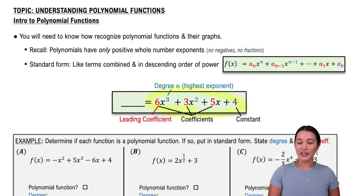
Introduction to Polynomial Functions

Cubic Functions

Cubic functions are polynomial functions of degree three, characterized by their general form Ζ’(𝓍) = 𝓍³ + axΒ² + bx + c. They can have one, two, or three real roots, depending on their discriminant. The shape of the graph of a cubic function can exhibit various behaviors, such as having inflection points and local maxima or minima, which are crucial for analyzing the function's properties.
Recommended video:
06:21
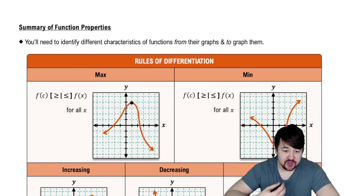
Properties of Functions

Exact vs. Approximate Values

In calculus, the distinction between exact and approximate values is important for understanding solutions to equations. An exact value is a precise mathematical expression, such as (1/2 + √69/18)¹/³ + (1/2 - √69/18)¹/³, while an approximate value is a numerical estimate obtained through methods like numerical approximation or graphing. Comparing these values helps assess the accuracy of numerical methods used in solving equations.
Recommended video:
04:25
Average Value of a Function Example 1
Related Practice
Textbook Question

Find the limits in Exercises 49–52. Write ∞ or βˆ’βˆž where appropriate.


lim xβ†’(βˆ’Ο€/2)⁺ sec x

Textbook Question

[Technology Exercise] Roots


Let Ζ’(𝓍) = 𝓍³ ―𝓍― 1.


b. Solve the equation Ζ’(𝓍) = 0 graphically with an error of magnitude at most 10⁻⁸ .

Textbook Question

The accompanying graph shows the total amount of gasoline A in the gas tank of an automobile after it has been driven for t days.

c. Estimate the maximum rate of gasoline consumption and the specific time at which it occurs.

Textbook Question

Finding Deltas Algebraically


Each of Exercises 15–30 gives a function f(x) and numbers L, c, and Ξ΅>0. In each case, find the largest open interval about c on which the inequality |f(x)βˆ’L| <Ξ΅ holds. Then give a value for Ξ΄>0 such that for all x satisfying 0 < |xβˆ’c| < Ξ΄, the inequality |f(x)βˆ’L| < Ξ΅ holds.


f(x) = mx, m > 0, L = 2m, c = 2, Ξ΅ = 0.03

Textbook Question

Continuous Extension


Explain why the function Ζ’(𝓍) = sin(1/𝓍) has no continuous extension to 𝓍 = 0.

Textbook Question

[Technology Exercise] In Exercises 33–36, graph the function to see whether it appears to have a continuous extension to the given point a. If it does, use Trace and Zoom to find a good candidate for the extended function’s value at a. If the function does not appear to have a continuous extension, can it be extended to be continuous from the right or left? If so, what do you think the extended function’s value should be?


g(ΞΈ) = 5 cos ΞΈ / (4ΞΈ ― 2Ο€) , a = Ο€/2