Ch. 2 - Limits and Continuity
Hass - Thomas' Calculus 15th Edition
Hass15th EditionThomas' CalculusISBN: 9780137616077Not the one you use?Change textbook
Chapter 2, Problem 2.2.54c

Suppose limx→4 f(x) = 0 and lim x→4 g(x) = −3. Find


c. limx→4 (g(x))²

Verified step by step guidance
1
First, understand that the problem involves finding the limit of a function as x approaches a certain value. In this case, we are looking for limx→4 (g(x))².
Recall the limit property: if limx→a g(x) = L, then limx→a (g(x))² = L², provided the limit exists.
Given that limx→4 g(x) = -3, we can apply this property to find the limit of (g(x))².
Substitute the known limit value into the expression: limx→4 (g(x))² = (-3)².
Finally, calculate the square of the limit value: (-3)². This will give you the limit of (g(x))² as x approaches 4.

Verified video answer for a similar problem:

This video solution was recommended by our tutors as helpful for the problem above.
Video duration:
1m
Was this helpful?

Key Concepts

Here are the essential concepts you must grasp in order to answer the question correctly.

Limit of a Function

The limit of a function describes the value that a function approaches as the input approaches a certain point. In this case, we are interested in the behavior of the functions f(x) and g(x) as x approaches 4. Understanding limits is fundamental in calculus, as it lays the groundwork for concepts such as continuity and derivatives.
Recommended video:
06:11
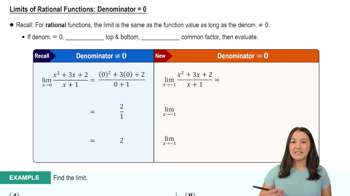
Limits of Rational Functions: Denominator = 0

Properties of Limits

Limits have several properties that simplify the evaluation of expressions. One important property is that the limit of a product or a power can be computed using the limits of the individual functions. Specifically, if limx→a g(x) exists, then limx→a (g(x))² = (limx→a g(x))², which allows us to find the limit of g(x) squared directly from the limit of g(x).
Recommended video:
06:21
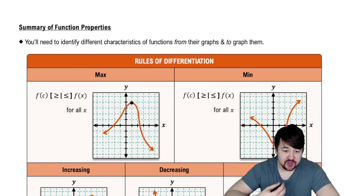
Properties of Functions

Continuous Functions

A function is continuous at a point if the limit of the function as it approaches that point equals the function's value at that point. While the question does not explicitly state continuity, knowing that limits exist for both f(x) and g(x) suggests that g(x) behaves predictably around x = 4, allowing us to confidently compute the limit of (g(x))².
Recommended video:
05:34
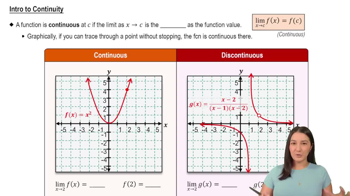
Intro to Continuity