
Textbook Question
Domains and Asymptotes
Determine the domain of each function in Exercises 69–72. Then use various limits to find the asymptotes.
y = 4 + 3x² / (x² + 1)

 Verified step by step guidance
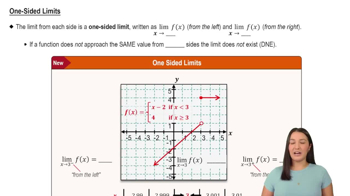
 05:50
05:50
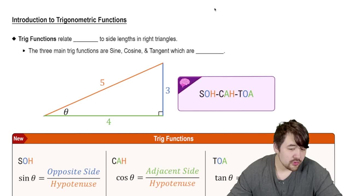 6:04
6:04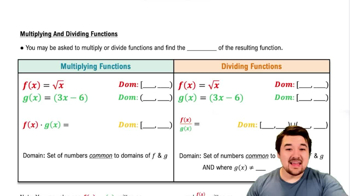 7:24
7:24Domains and Asymptotes
Determine the domain of each function in Exercises 69–72. Then use various limits to find the asymptotes.
y = 4 + 3x² / (x² + 1)
Using limθ→0 sin θ / θ = 1
Find the limits in Exercises 23–46.
limh→0− h / sin 3h
Finding Limits of Differences When x → ±∞
Find the limits in Exercises 84–90. (Hint: Try multiplying and dividing by the conjugate.)
lim x → ∞ (√(x + 9) − √(x + 4))
Using the Formal Definition
Prove the limit statements in Exercises 37–50.
limx→1 f(x) = 1 if f(x) = {x², x ≠ 1
2, x = 1
At what points are the functions in Exercises 13–30 continuous?
f(x) = { (x³ − 8)/(x² − 4), x ≠ 2, x ≠ −2
3, x = 2
4, x = −2
Limits of Average Rates of Change
Because of their connection with secant lines, tangents, and instantaneous rates, limits of the form limh→0 (f(x+h) − f(x)) / h occur frequently in calculus. In Exercises 57–62, evaluate this limit for the given value of x and function f.
f(x) = x², x = 1