
Textbook Question
Theory and Examples
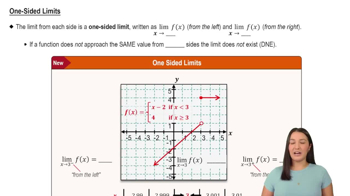
Suppose that f is an odd function of x. Does knowing that limx→0+ f(x) = 3 tell you anything about limx→0− f(x)? Give reasons for your answer.

 Verified step by step guidance
 05:50
05:50
 6:04
6:04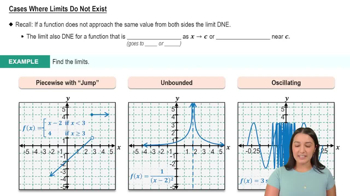 03:07
03:07Theory and Examples
Suppose that f is an odd function of x. Does knowing that limx→0+ f(x) = 3 tell you anything about limx→0− f(x)? Give reasons for your answer.
Slope of a Curve at a Point
In Exercises 7–18, use the method in Example 3 to find (a) the slope of the curve at the given point P, and (b) an equation of the tangent line at P.
y=x³−3x²+4, P(2,0)
Limits of quotients
Find the limits in Exercises 23–42.
limx→−5 (x² + 3x − 10) / x + 5
Explain why the equation cos x = x has at least one solution.
Suppose that a function f(x) is defined for all real values of x except x=c. Can anything be said about the existence of limx→c f(x)? Give reasons for your answer.
Removable discontinuity Give an example of a function f (x) that is continuous for all values of x except x = 2, where it has a removable discontinuity. Explain how you know that f is discontinuous at x = 2, and how you know the discontinuity is removable.