Ch. 2 - Limits and Continuity
Hass - Thomas' Calculus 15th Edition
Hass15th EditionThomas' CalculusISBN: 9780137616077Not the one you use?Change textbook
Chapter 2, Problem 2.2.29

Limits of quotients


Find the limits in Exercises 23–42.


limt→−2 (−2x − 4) / (x³ + 2x²)

Verified step by step guidance
1
Step 1: Identify the type of limit problem. This is a limit of a quotient as x approaches -2. We need to evaluate lim_{x→−2} (−2x − 4) / (x³ + 2x²).
Step 2: Check if direct substitution is possible. Substitute x = -2 into the numerator and denominator to see if it results in an indeterminate form like 0/0.
Step 3: Simplify the expression. Factor the denominator x³ + 2x² to see if it can be simplified. The denominator can be factored as x²(x + 2).
Step 4: Cancel common factors. If the numerator and denominator have common factors, cancel them to simplify the expression. Check if the numerator −2x − 4 can be factored to find common factors with the denominator.
Step 5: Evaluate the limit. After simplifying, substitute x = -2 again to find the limit. If the expression is still indeterminate, consider using L'Hôpital's Rule or further algebraic manipulation.

Verified video answer for a similar problem:

This video solution was recommended by our tutors as helpful for the problem above.
Video duration:
1m
Was this helpful?

Key Concepts

Here are the essential concepts you must grasp in order to answer the question correctly.

Limits

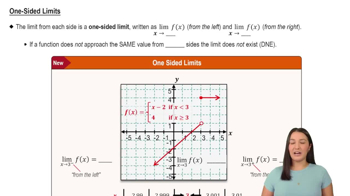
Limits are fundamental in calculus, representing the value that a function approaches as the input approaches a certain point. They help in understanding the behavior of functions near specific points, especially where they may not be defined. In this case, evaluating the limit as x approaches -2 will reveal the behavior of the quotient function near that point.
Recommended video:
05:50
One-Sided Limits

Quotient of Functions

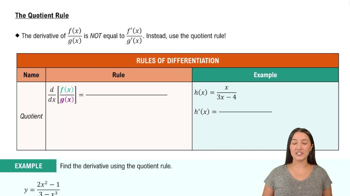
The quotient of functions involves dividing one function by another. When finding limits of quotients, it is essential to consider the behavior of both the numerator and denominator as the variable approaches a specific value. If the denominator approaches zero, it may lead to undefined behavior or require further analysis, such as factoring or applying L'Hôpital's Rule.
Recommended video:
06:43
The Quotient Rule

Factoring and Simplifying

Factoring and simplifying expressions is a crucial step in limit problems, especially when dealing with quotients. By factoring the numerator and denominator, one can often cancel common terms, which can help eliminate indeterminate forms like 0/0. This simplification allows for easier evaluation of the limit as the variable approaches the specified value.
Recommended video:
6:36
Simplifying Trig Expressions