
Textbook Question
Theory and Examples
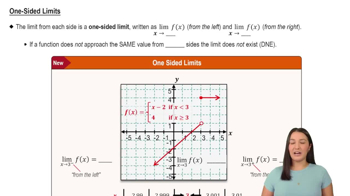
Suppose that f is an odd function of x. Does knowing that limx→0+ f(x) = 3 tell you anything about limx→0− f(x)? Give reasons for your answer.

 Verified step by step guidance
 05:50
05:50 05:50
05:50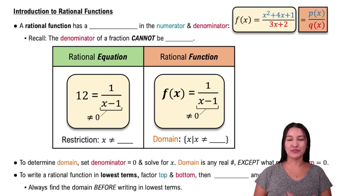 6:04
6:04Theory and Examples
Suppose that f is an odd function of x. Does knowing that limx→0+ f(x) = 3 tell you anything about limx→0− f(x)? Give reasons for your answer.
Domains and Asymptotes
Determine the domain of each function in Exercises 69–72. Then use various limits to find the asymptotes.
y = (√(x² + 4)) / x
Finding Deltas Algebraically
Each of Exercises 15–30 gives a function f(x) and numbers L, c, and ε>0. In each case, find the largest open interval about c on which the inequality |f(x)−L| <ε holds. Then give a value for δ>0 such that for all x satisfying 0 < |x−c| < δ, the inequality |f(x)−L| < ε holds.
f(x) = 1/x, L = 1/4, c = 4, ε = 0.05
Graphing Simple Rational Functions
Graph the rational functions in Exercises 63–68. Include the graphs and equations of the asymptotes and dominant terms.
y = −3/(x − 3)
Limits with trigonometric functions
Find the limits in Exercises 43–50.
limx→0 (1 + x + sin x) / (3 cosx)
Slope of a Curve at a Point
In Exercises 7–18, use the method in Example 3 to find (a) the slope of the curve at the given point P, and (b) an equation of the tangent line at P.
y=x³−3x²+4, P(2,0)