
Textbook Question
Finding One-Sided Limits Algebraically
Find the limits in Exercises 11–20.
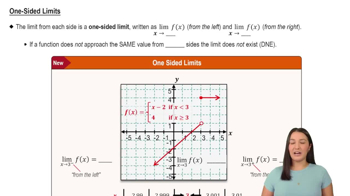
limh→0− (√6 − √(5h² + 11h + 6))/ h

 Verified step by step guidance
 05:50
05:50
 6:04
6:04 5:50
5:50Finding One-Sided Limits Algebraically
Find the limits in Exercises 11–20.
limh→0− (√6 − √(5h² + 11h + 6))/ h
Limits as x → ∞ or x → −∞
The process by which we determine limits of rational functions applies equally well to ratios containing noninteger or negative powers of x. Divide numerator and denominator by the highest power of x in the denominator and proceed from there. Find the limits in Exercises 23–36. Write ∞ or −∞ where appropriate.
lim x→∞ (x − 3) / √(4x² + 25)
Centering Intervals About a Point
In Exercises 1–6, sketch the interval (a,b), on the x-axis with the point c inside. Then find a value of δ>0 such that a < x < b whenever 0 < |x−c| < δ.
a=4/9, b=4/7, c=1/2
Using the Formal Definition
Prove the limit statements in Exercises 37–50.
limx→3 (3x − 7) = 2
Theory and Examples
If limx→4 (f(x) − 5) / (x − 2) = 1, find limx→4 f(x).
Finding Limits of Differences When x → ±∞
Find the limits in Exercises 84–90. (Hint: Try multiplying and dividing by the conjugate.)
lim x → ∞ (√(x² + 25) − √(x² − 1))