
Textbook Question
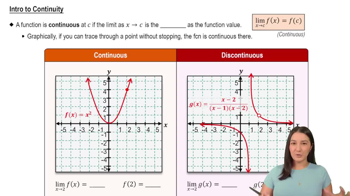
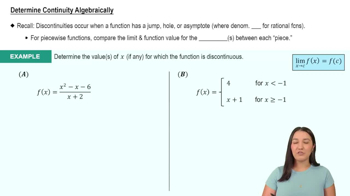
At what points are the functions in Exercises 13–30 continuous?
y = (2x – 1)¹/³

 Verified step by step guidance
 05:34
05:34
 05:25
05:25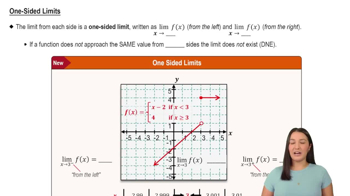 05:50
05:50At what points are the functions in Exercises 13–30 continuous?
y = (2x – 1)¹/³
Use the Intermediate Value Theorem in Exercises 69–74 to prove that each equation has a solution. Then use a graphing calculator or computer grapher to solve the equations.
x³ − 3x − 1 = 0
In Exercises 77–80, find a function that satisfies the given conditions and sketch its graph. (The answers here are not unique. Any function that satisfies the conditions is acceptable. Feel free to use formulas defined in pieces if that will help.)
lim x → ±∞ k(x) = 1, lim x → 1⁻ k(x) = ∞, and lim x → 1⁺ k(x) = −∞
Suppose limx→c f(x) = 5 and lim x→c g(x) = −2. Find
b. limx→c 2f(x)g(x)
Using the Sandwich Theorem
a. Suppose that the inequalities 1/2 − x² / 24 < (1 − cos x)/ x² < 1/2 hold for values of x close to zero, except for x = 0 itself. (They do, as you will see in Section 9.9.) What, if anything, does this tell you about limx→0 (1 −cos x)/ x²?
Give reasons for your answer.
[Technology Exercise] b. Graph the equations y=(1/2) − (x²/24), y = (1 - cos x) / x², and y = 1/2 together for −2 ≤ x ≤2. Comment on the behavior of the graphs as x→0.
Suppose that a function f(x) is defined for all x in [-1,1]. Can anything be said about the existence of limx→0 f(x)? Give reasons for your answer.