
Ch. 2 - Limits and Continuity
Hass - Thomas' Calculus 15th Edition
Hass15th EditionThomas' CalculusISBN: 9780137616077Not the one you use?Change textbook
Chapter 2, Problem 2.28

Finding Limits
In Exercises 25–28, find the limit of g(x) as x approaches the indicated value.


5 ―x²
lim ------------- = 0
x → ―2 (√g(x))

Verified step by step guidance
1
Identify the function g(x) given in the problem. Here, g(x) is not explicitly defined, but we are given an expression involving g(x) in the limit.
Rewrite the limit expression in a more standard form. The problem states: lim (5 - x²) / (√g(x)) as x approaches -2. This suggests that g(x) is related to the expression in the denominator.
Assume that g(x) is such that the expression (5 - x²) / (√g(x)) is defined and continuous around x = -2. This might involve simplifying or rationalizing the expression.
Evaluate the limit by substituting x = -2 into the expression, if possible. If direct substitution leads to an indeterminate form, consider using algebraic manipulation or L'Hôpital's Rule to resolve the indeterminate form.
Conclude by stating the limit value, ensuring that the steps taken are consistent with the properties of limits and continuity.

Verified video answer for a similar problem:

This video solution was recommended by our tutors as helpful for the problem above.
Video duration:
2m
Was this helpful?

Key Concepts

Here are the essential concepts you must grasp in order to answer the question correctly.

Limits

A limit is a fundamental concept in calculus that describes the behavior of a function as its input approaches a certain value. It helps in understanding how functions behave near specific points, even if they are not defined at those points. For example, the limit of a function can indicate whether it approaches a finite value, infinity, or does not exist as the input approaches a particular value.
Recommended video:
05:50
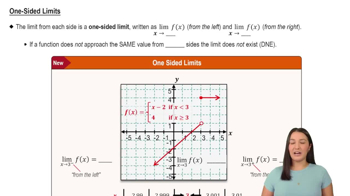
One-Sided Limits

Continuous Functions

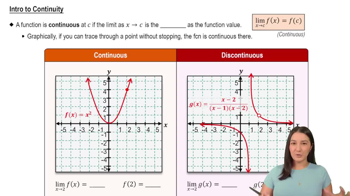
A function is continuous at a point if the limit of the function as it approaches that point equals the function's value at that point. This concept is crucial when evaluating limits, as discontinuities can lead to different limit behaviors. Understanding continuity helps in determining whether the limit can be directly substituted or requires further analysis.
Recommended video:
05:34
Intro to Continuity

Rational Functions

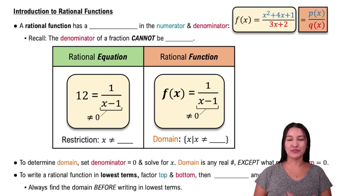
Rational functions are ratios of polynomials, and their limits can often be evaluated by simplifying the expression. When finding limits involving rational functions, it is important to identify any points of discontinuity, such as holes or vertical asymptotes, which can affect the limit's value. Techniques like factoring and canceling common terms are often employed to simplify the limit calculation.
Recommended video:
6:04
Intro to Rational Functions