Ch. 2 - Limits and Continuity
Hass - Thomas' Calculus 15th Edition
Hass15th EditionThomas' CalculusISBN: 9780137616077Not the one you use?Change textbook
Chapter 2, Problem 2.6.61a

Find the limits in Exercises 59–62. Write ∞ or −∞ where appropriate.


lim ( 1 / x²/³ + 2 / (x − 1)²/³ ) as


a. x → 0⁺

Verified step by step guidance
1
Step 1: Understand the problem. We need to find the limit of the expression \( \frac{1}{x^{2/3}} + \frac{2}{(x - 1)^{2/3}} \) as \( x \to 0^+ \). This means we are approaching 0 from the positive side.
Step 2: Analyze the behavior of each term separately as \( x \to 0^+ \). For the term \( \frac{1}{x^{2/3}} \), as \( x \) approaches 0 from the positive side, \( x^{2/3} \) approaches 0, making \( \frac{1}{x^{2/3}} \) approach infinity.
Step 3: Consider the second term \( \frac{2}{(x - 1)^{2/3}} \). As \( x \to 0^+ \), \( x - 1 \) approaches -1. Therefore, \( (x - 1)^{2/3} \) approaches \((-1)^{2/3}\), which is a real number. Thus, \( \frac{2}{(x - 1)^{2/3}} \) approaches a finite value.
Step 4: Combine the behavior of both terms. The first term \( \frac{1}{x^{2/3}} \) dominates the behavior of the limit because it approaches infinity, while the second term approaches a finite value.
Step 5: Conclude the limit. Since the first term approaches infinity and dominates the expression, the limit of the entire expression as \( x \to 0^+ \) is infinity.

Verified video answer for a similar problem:

This video solution was recommended by our tutors as helpful for the problem above.
Video duration:
3m
Was this helpful?

Key Concepts

Here are the essential concepts you must grasp in order to answer the question correctly.

Limits

A limit in calculus describes the value that a function approaches as the input approaches a certain point. Understanding limits is crucial for analyzing the behavior of functions at points where they may not be explicitly defined, such as points of discontinuity or infinity.
Recommended video:
05:50
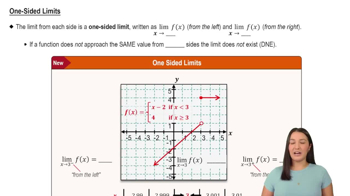
One-Sided Limits

Indeterminate Forms

Indeterminate forms occur when evaluating limits leads to expressions like 0/0 or ∞/∞, which do not have a clear value. Recognizing these forms is essential for applying techniques like L'Hôpital's Rule or algebraic manipulation to find the actual limit.
Recommended video:
Guided course
3:56
Slope-Intercept Form

Behavior Near Zero

Analyzing the behavior of functions as x approaches zero involves understanding how terms in the function behave, especially when they involve powers or roots. This is important for determining whether the function approaches a finite value, infinity, or negative infinity as x approaches zero from the positive side.
Recommended video:
Guided course
6:37
Zero and Negative Rules