Ch. 2 - Limits and Continuity
Hass - Thomas' Calculus 15th Edition
Hass15th EditionThomas' CalculusISBN: 9780137616077Not the one you use?Change textbook
Chapter 2, Problem 54d

Find the limits in Exercises 53–58. Write ∞ or −∞ where appropriate.


lim x/(x² − 1) as


d. x→−1⁻

Verified step by step guidance
1
Step 1: Understand the problem. We need to find the limit of the function \( \frac{x}{x^2 - 1} \) as \( x \) approaches \( -1 \) from the left (denoted as \( x \to -1^- \)). This involves analyzing the behavior of the function as \( x \) gets very close to \( -1 \) from values less than \( -1 \).
Step 2: Factor the denominator. The expression \( x^2 - 1 \) can be factored using the difference of squares formula: \( x^2 - 1 = (x - 1)(x + 1) \). This will help us understand the behavior of the function near \( x = -1 \).
Step 3: Analyze the sign of the denominator near \( x = -1 \). As \( x \to -1^- \), \( x + 1 \) approaches 0 from the negative side, and \( x - 1 \) is negative. Therefore, the product \( (x - 1)(x + 1) \) is positive.
Step 4: Consider the numerator. The numerator \( x \) approaches \( -1 \) as \( x \to -1^- \). Since \( x \) is negative and the denominator is positive, the overall expression \( \frac{x}{x^2 - 1} \) will be negative.
Step 5: Determine the limit. As \( x \to -1^- \), the denominator \( (x - 1)(x + 1) \) approaches 0, causing the fraction \( \frac{x}{x^2 - 1} \) to become very large in magnitude but negative in sign. Therefore, the limit is \( -\infty \).

Verified video answer for a similar problem:

This video solution was recommended by our tutors as helpful for the problem above.
Video duration:
3m
Was this helpful?

Key Concepts

Here are the essential concepts you must grasp in order to answer the question correctly.

Limits

Limits are fundamental concepts in calculus that describe the behavior of a function as its input approaches a certain value. They help in understanding how functions behave near points of interest, including points of discontinuity or infinity. In this case, we are interested in the limit of the function as x approaches -1 from the left.
Recommended video:
05:50
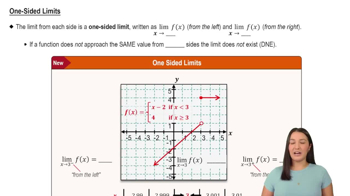
One-Sided Limits

One-Sided Limits

One-sided limits refer to the value that a function approaches as the input approaches a specific point from one side only, either the left (denoted as x→a⁻) or the right (denoted as x→a⁺). This is crucial for analyzing functions that may behave differently from each side of a point, particularly at points of discontinuity or vertical asymptotes.
Recommended video:
05:50
One-Sided Limits

Rational Functions

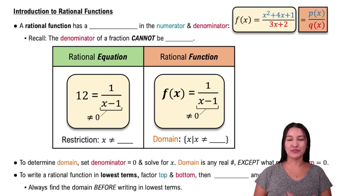
Rational functions are expressions formed by the ratio of two polynomials. The behavior of these functions can vary significantly based on their numerator and denominator. In this limit problem, the function x/(x² - 1) is a rational function, and understanding its structure helps in determining the limit as x approaches -1, especially since the denominator can lead to undefined behavior.
Recommended video:
6:04
Intro to Rational Functions