
Ch. 11 - Parametric Equations and Polar Coordinates
Hass - Thomas' Calculus 15th Edition
Hass15th EditionThomas' CalculusISBN: 9780137616077Not the one you use?Change textbook
Chapter 11, Problem 11.4.6

Symmetries and Polar Graphs


Identify the symmetries of the curves in Exercises 1–12. Then sketch the curves in the xy-plane.


r = 1 + 2 sin θ

Verified step by step guidance
1
Recall that to identify symmetries of a polar curve given by \(r = f(\theta)\), we check for symmetry about the polar axis (the x-axis), the line \(\theta = \frac{\pi}{2}\) (the y-axis), and the pole (origin).
For symmetry about the polar axis, replace \(\theta\) by \(-\theta\) and see if the equation remains unchanged or can be manipulated to the original form. That is, check if \(r = 1 + 2 \sin(-\theta)\) simplifies to the original \(r\).
For symmetry about the line \(\theta = \frac{\pi}{2}\), replace \(\theta\) by \(\pi - \theta\) and check if \(r = 1 + 2 \sin(\pi - \theta)\) simplifies to the original \(r\).
For symmetry about the pole (origin), replace \(r\) by \(-r\) and \(\theta\) by \(\theta + \pi\), and check if \(-r = 1 + 2 \sin(\theta + \pi)\) can be rearranged to the original equation.
After determining the symmetries, sketch the curve by plotting points for various values of \(\theta\) between \(0\) and \(2\pi\), using the equation \(r = 1 + 2 \sin \theta\), and then reflect the curve according to the symmetries found.

Verified video answer for a similar problem:

This video solution was recommended by our tutors as helpful for the problem above.
Video duration:
9m
Was this helpful?

Key Concepts

Here are the essential concepts you must grasp in order to answer the question correctly.

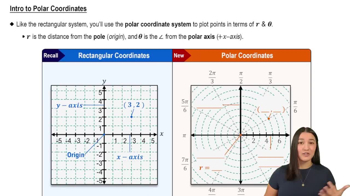
Polar Coordinates and Graphing

Polar coordinates represent points using a radius r and an angle θ, differing from Cartesian coordinates. Understanding how to plot points given r(θ) is essential for sketching curves like r = 1 + 2 sin θ, where r changes with θ from 0 to 2π.
Recommended video:
05:32
Intro to Polar Coordinates

Symmetry in Polar Graphs

Symmetry in polar graphs can occur about the polar axis, the line θ = π/2, or the pole (origin). Testing the function for transformations like replacing θ with -θ, π - θ, or θ + π helps identify these symmetries, which simplifies sketching and understanding the curve.
Recommended video:
05:32
Intro to Polar Coordinates

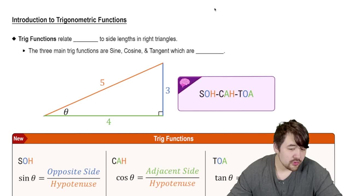
Trigonometric Functions in Polar Equations

Trigonometric functions like sine and cosine influence the shape and symmetry of polar graphs. For r = 1 + 2 sin θ, the sine term affects the radius depending on θ, creating characteristic shapes such as limacons, cardioids, or loops, which are important to recognize.
Recommended video:
6:04
Introduction to Trigonometric Functions