Ch. 11 - Parametric Equations and Polar Coordinates
Hass - Thomas' Calculus 15th Edition
Hass15th EditionThomas' CalculusISBN: 9780137616077Not the one you use?Change textbook
Chapter 11, Problem 11.1.14

Finding Cartesian from Parametric Equations


Exercises 1–18 give parametric equations and parameter intervals for the motion of a particle in the xy-plane. Identify the particle’s path by finding a Cartesian equation for it. Graph the Cartesian equation. (The graphs will vary with the equation used.) Indicate the portion of the graph traced by the particle and the direction of motion.


x=√(t+1), y=√t, t ≥ 0

Verified step by step guidance
1
Start with the given parametric equations: \(x = \sqrt{t+1}\) and \(y = \sqrt{t}\), where \(t \geq 0\).
Express both \(x\) and \(y\) in terms of \(t\) squared to eliminate the square roots: \(x^2 = t + 1\) and \(y^2 = t\).
Use the expression for \(y^2\) to substitute for \(t\) in the equation for \(x^2\): \(x^2 = y^2 + 1\).
Rewrite the equation to isolate terms and get the Cartesian form: \(x^2 - y^2 = 1\).
Analyze the parameter interval \(t \geq 0\) to determine the portion of the graph traced by the particle and the direction of motion by considering how \(x\) and \(y\) change as \(t\) increases.

Verified video answer for a similar problem:

This video solution was recommended by our tutors as helpful for the problem above.
Video duration:
4m
Was this helpful?

Key Concepts

Here are the essential concepts you must grasp in order to answer the question correctly.

Parametric Equations

Parametric equations express the coordinates of points on a curve as functions of a parameter, often denoted as t. Instead of y as a function of x, both x and y depend on t, allowing the description of more complex paths and motions in the plane.
Recommended video:
Guided course
08:02
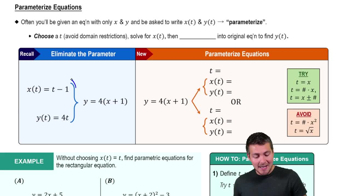
Parameterizing Equations

Eliminating the Parameter to Find Cartesian Equations

To find a Cartesian equation from parametric equations, solve one parametric equation for the parameter and substitute into the other. This process removes the parameter, yielding a direct relationship between x and y that describes the particle's path.
Recommended video:
Guided course
04:11
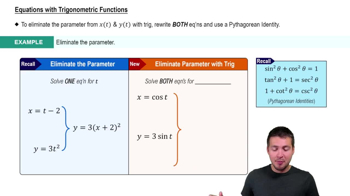
Eliminate Parameter: Equations with Trig

Graphing and Interpreting the Particle's Path and Direction

After finding the Cartesian equation, graph it to visualize the path. Use the parameter interval to determine which portion of the curve is traced and analyze how the parameter changes to indicate the direction of motion along the path.
Recommended video:
02:55
Graphing The Derivative - Special Cases Example 2