
Textbook Question
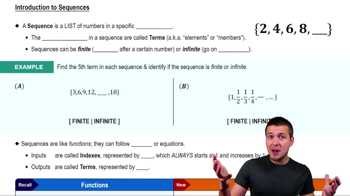
Finding Terms of a Sequence
Each of Exercises 1–6 gives a formula for the nth term aₙ of a sequence {aₙ}. Find the values of a₁, a₂, a₃, and a₄.
aₙ = 2 + (-1)ⁿ
1
views

 Verified step by step guidance
 8:22
8:22
 09:25
09:25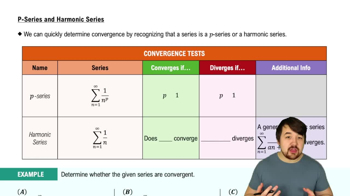 04:30
04:30Finding Terms of a Sequence
Each of Exercises 1–6 gives a formula for the nth term aₙ of a sequence {aₙ}. Find the values of a₁, a₂, a₃, and a₄.
aₙ = 2 + (-1)ⁿ
Determining Convergence or Divergence
Which of the series in Exercises 13–46 converge, and which diverge? Give reasons for your answers. (When you check an answer, remember that there may be more than one way to determine the series’ convergence or divergence.)
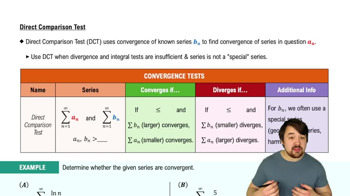
∑ (from n=1 to ∞) (1 + 1/n)ⁿ
Absolute and Conditional Convergence
Which of the series in Exercises 15–48 converge absolutely, which converge, and which diverge? Give reasons for your answers.
∑ (from n = 1 to ∞) [(-1)ⁿ⁺¹ (ⁿ√10)]
Which series in Exercises 53–76 converge, and which diverge? Give reasons for your answers. If a series converges, find its sum.
∑ (from n = 0 to ∞) e^(−2n)
Does the series
∑ (from n=1 to ∞) (1/n − 1/n²)
converge or diverge? Justify your answer.
In Exercises 57–82, use any method to determine whether the series converges or diverges. Give reasons for your answer.
∑ (from n = 0 to ∞) [((n + 1) / (n + 2))ⁿ]