
Textbook Question
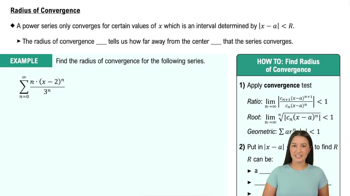
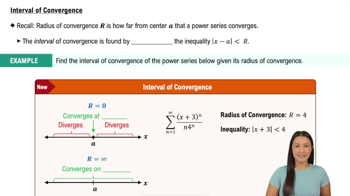
Assume that bₙ is a sequence of positive numbers converging to 1/3. Determine if the following series converge or diverge.
a. ∑ (from n = 1 to ∞) [(bₙ₊₁ + bₙ) / n 4ⁿ]
1
views

 Verified step by step guidance
 07:36
07:36
 08:44
08:44 04:45
04:45Assume that bₙ is a sequence of positive numbers converging to 1/3. Determine if the following series converge or diverge.
a. ∑ (from n = 1 to ∞) [(bₙ₊₁ + bₙ) / n 4ⁿ]
∑ (from n=1 to ∞) (1 / √(n + 1)) diverges
b. What should n be in order that the partial sum sₙ = ∑ (from i=1 to n) (1 / √(i + 1)) satisfies sₙ > 1000?
Quadratic Approximations The Taylor polynomial of order 2 generated by a twice-differentiable function f(x) at x = a is called the quadratic approximation of f at x = a. In Exercises 41–46, find the (a) linearization (Taylor polynomial of order 1)
f(x) = ln(cos x)
Quadratic Approximations The Taylor polynomial of order 2 generated by a twice-differentiable function f(x) at x = a is called the quadratic approximation of f at x = a. In Exercises 41–46, find the (a) linearization (Taylor polynomial of order 1)
f(x) = 1 / √(1 − x²)
Intervals of Convergence
In Exercises 1–36, for what values of x does the series converge (b) absolutely?
∑ (from n = 0 to ∞) [ (−2)ⁿ (n + 1) (x − 1)ⁿ ]
The series
eˣ = 1 + x + x²/2! + x³/3! + x⁴/4! + x⁵/5! + ⋯
converges to eˣ for all x.
a. Find a series for (d/dx)eˣ. Do you get the series for eˣ? Explain your answer.