Ch. 10 - Infinite Sequences and Series
Hass - Thomas' Calculus 15th Edition
Hass15th EditionThomas' CalculusISBN: 9780137616077Not the one you use?Change textbook
Chapter 10, Problem 10.8.37

In Exercises 35–40, find the first three nonzero terms of the Maclaurin series for each function.
f(x) = (sin x) ln(1 + x)

Verified step by step guidance
1
Recall that the Maclaurin series is the Taylor series expansion of a function about \(x = 0\). We want to find the first three nonzero terms of the Maclaurin series for \(f(x) = (\sin x) \ln(1 + x)\).
Write down the Maclaurin series expansions for each component function separately: \(\sin x = \sum_{n=0}^\infty (-1)^n \frac{x^{2n+1}}{(2n+1)!} = x - \frac{x^3}{3!} + \frac{x^5}{5!} - \cdots\) and \(\ln(1+x) = \sum_{n=1}^\infty (-1)^{n+1} \frac{x^n}{n} = x - \frac{x^2}{2} + \frac{x^3}{3} - \cdots\).
Multiply the two series together term-by-term, keeping track of powers of \(x\). Specifically, multiply each term of \(\sin x\) by each term of \(\ln(1+x)\) and combine like powers of \(x\).
Identify and collect the first three nonzero terms from the resulting series after multiplication. This involves adding coefficients of like powers of \(x\) and ignoring terms that are zero.
Write the resulting expression as the sum of these first three nonzero terms, which will be the beginning of the Maclaurin series for \(f(x) = (\sin x) \ln(1 + x)\).

Verified video answer for a similar problem:

This video solution was recommended by our tutors as helpful for the problem above.
Video duration:
4m
Was this helpful?

Key Concepts

Here are the essential concepts you must grasp in order to answer the question correctly.

Maclaurin Series

A Maclaurin series is a Taylor series expansion of a function about zero. It expresses the function as an infinite sum of terms involving derivatives evaluated at zero, allowing approximation of the function near x = 0.
Recommended video:
08:26
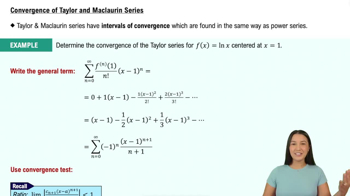
Convergence of Taylor & Maclaurin Series

Series Expansion of Elementary Functions

Common functions like sin(x) and ln(1 + x) have known Maclaurin series expansions. Understanding these expansions helps in combining or manipulating series to find the series of more complex functions.
Recommended video:
06:00
Geometric Series

Multiplication of Power Series

To find the Maclaurin series of a product like (sin x)·ln(1 + x), multiply the individual series term-by-term and combine like powers of x. This process requires careful organization to identify the first nonzero terms.
Recommended video:
05:58
Intro to Power Series