Ch. 10 - Infinite Sequences and Series
Hass - Thomas' Calculus 15th Edition
Hass15th EditionThomas' CalculusISBN: 9780137616077Not the one you use?Change textbook
Chapter 10, Problem 10.9.45

Error Estimates
The approximation eˣ = 1 + x + (x² / 2) is used when x is small. Use the Remainder Estimation Theorem to estimate the error when |x| < 0.1.

Verified step by step guidance
1
Identify the Taylor polynomial used for approximating \(e^x\). Here, the approximation is \(1 + x + \frac{x^2}{2}\), which corresponds to the Taylor polynomial of degree 2 centered at 0.
Recall the Remainder Estimation Theorem (Lagrange form of the remainder) for the Taylor polynomial of degree \(n\): the error \(R_n(x)\) satisfies \(R_n(x) = \frac{f^{(n+1)}(c)}{(n+1)!} x^{n+1}\) for some \(c\) between 0 and \(x\).
Since the polynomial is degree 2, the remainder term involves the third derivative of \(f(x) = e^x\). Note that all derivatives of \(e^x\) are \(e^x\), so \(f^{(3)}(c) = e^c\).
To estimate the error when \(|x| < 0.1\), find an upper bound for \(|R_2(x)|\) by bounding \(|e^c|\) for \(c\) between 0 and \(x\). Since \(|x| < 0.1\), \(c\) lies in \([-0.1, 0.1]\), and \(e^c\) is maximized at \(c = 0.1\).
Write the error bound as \(|R_2(x)| \leq \frac{e^{0.1}}{3!} |x|^3 = \frac{e^{0.1}}{6} |x|^3\). This expression gives an estimate of the maximum error when using the given approximation for \(|x| < 0.1\).

Verified video answer for a similar problem:

This video solution was recommended by our tutors as helpful for the problem above.
Video duration:
3m
Was this helpful?

Key Concepts

Here are the essential concepts you must grasp in order to answer the question correctly.

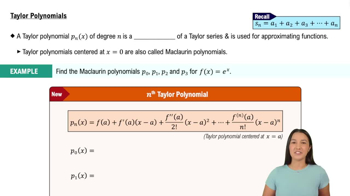
Taylor Polynomial Approximation

A Taylor polynomial approximates a function near a point using a finite sum of its derivatives at that point. For eˣ, the polynomial 1 + x + (x² / 2) is the second-degree Taylor polynomial centered at 0, providing a close estimate when x is near zero.
Recommended video:
07:00
Taylor Polynomials

Remainder Estimation Theorem (Lagrange Form)

This theorem gives a bound on the error between a function and its Taylor polynomial approximation. It states that the remainder term is bounded by the maximum value of the next derivative times |x|^(n+1) divided by (n+1)!, ensuring control over the approximation error.
Recommended video:
07:59
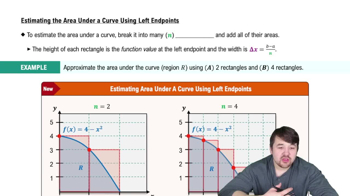
Estimating the Area Under a Curve Using Left Endpoints

Bounding the Error for Small x

When |x| is small, higher powers of x become very small, reducing the error in the approximation. By evaluating the maximum of the next derivative on the interval and applying the remainder formula, one can estimate how close the polynomial is to the actual function value.
Recommended video:
04:57
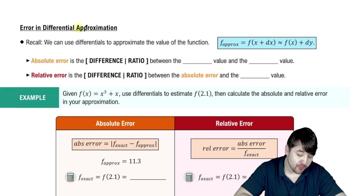
Determining Error and Relative Error