Ch. 10 - Infinite Sequences and Series
Hass - Thomas' Calculus 15th Edition
Hass15th EditionThomas' CalculusISBN: 9780137616077Not the one you use?Change textbook
Chapter 10, Problem 10.4.25

Determining Convergence or Divergence
Which of the series in Exercises 17–56 converge, and which diverge? Use any method, and give reasons for your answers.
∑ (from n=1 to ∞) (n / (3n + 1))ⁿ

Verified step by step guidance
1
Identify the given series: \( \sum_{n=1}^{\infty} \left( \frac{n}{3n + 1} \right)^n \). This is a series with terms raised to the power \(n\), suggesting the Root Test might be effective.
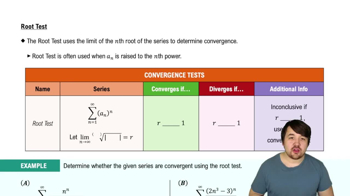
Recall the Root Test: For a series \( \sum a_n \), compute \( L = \lim_{n \to \infty} \sqrt[n]{|a_n|} \). If \( L < 1 \), the series converges absolutely; if \( L > 1 \), it diverges; if \( L = 1 \), the test is inconclusive.
Apply the Root Test to the terms \( a_n = \left( \frac{n}{3n + 1} \right)^n \). Compute \( \sqrt[n]{|a_n|} = \frac{n}{3n + 1} \).
Evaluate the limit \( L = \lim_{n \to \infty} \frac{n}{3n + 1} \). Simplify the expression by dividing numerator and denominator by \(n\) to find \( L = \lim_{n \to \infty} \frac{1}{3 + \frac{1}{n}} \).
Determine the value of \( L \) as \( n \to \infty \), then use the Root Test conclusion to decide if the series converges or diverges based on whether \( L < 1 \), \( L > 1 \), or \( L = 1 \).

Verified video answer for a similar problem:

This video solution was recommended by our tutors as helpful for the problem above.
Video duration:
3m
Was this helpful?

Key Concepts

Here are the essential concepts you must grasp in order to answer the question correctly.

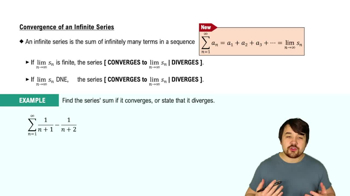
Convergence and Divergence of Infinite Series

An infinite series converges if the sum of its terms approaches a finite limit as the number of terms grows indefinitely. If the sum does not approach a finite value, the series diverges. Understanding this distinction is fundamental to analyzing series behavior.
Recommended video:
06:52
Convergence of an Infinite Series

Root Test for Series Convergence

The Root Test evaluates the limit of the nth root of the absolute value of the series terms. If this limit is less than 1, the series converges absolutely; if greater than 1, it diverges; if equal to 1, the test is inconclusive. This test is especially useful for series with terms raised to the nth power.
Recommended video:
07:15
Root Test

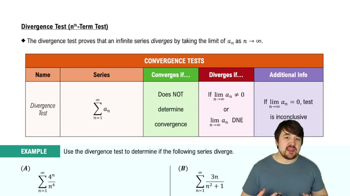
Behavior of the General Term

Examining the general term's behavior as n approaches infinity helps determine convergence. If the term does not approach zero, the series diverges. For terms like (n/(3n+1))^n, analyzing the base and its limit is crucial to apply convergence tests effectively.
Recommended video:
05:44
Divergence Test (nth Term Test)