Ch. 1 - Functions
Hass - Thomas' Calculus 15th Edition
Hass15th EditionThomas' CalculusISBN: 9780137616077Not the one you use?Change textbook
Chapter 1, Problem 53f

Shifting and Scaling Graphs


Suppose the graph of g is given. Write equations for the graphs that are obtained from the graph of g by shifting, scaling, or reflecting, as indicated.


f. Compress horizontally by a factor of 5

Verified step by step guidance
1
Start with the function g(x), which represents the original graph.
To compress the graph horizontally by a factor of 5, you need to modify the input variable x in the function g(x).
The horizontal compression by a factor of 5 means that every x-value is divided by 5. This is achieved by replacing x with 5x in the function.
Thus, the new function that represents the horizontally compressed graph is g(5x).
This transformation will make the graph appear narrower, as each point on the graph is now closer to the y-axis.

Verified video answer for a similar problem:

This video solution was recommended by our tutors as helpful for the problem above.
Video duration:
1m
Was this helpful?

Key Concepts

Here are the essential concepts you must grasp in order to answer the question correctly.

Horizontal Compression

Horizontal compression refers to the transformation of a graph where the x-coordinates of points on the graph are multiplied by a factor less than 1. In this case, compressing horizontally by a factor of 5 means that for every point (x, g(x)) on the graph of g, the new point will be (x/5, g(x)). This transformation effectively 'squeezes' the graph towards the y-axis.
Recommended video:
04:50
Critical Points

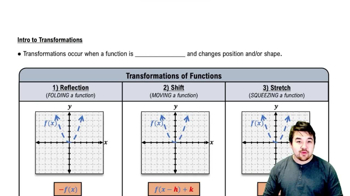
Function Transformation

Function transformations involve changing the position or shape of a graph through various operations such as shifting, scaling, or reflecting. Each transformation can be represented mathematically, allowing us to derive new functions from existing ones. Understanding these transformations is crucial for predicting how the graph will behave after modifications.
Recommended video:
5:25
Intro to Transformations

Graph of a Function

The graph of a function is a visual representation of the relationship between the input (x-values) and output (y-values) of the function. It provides insight into the function's behavior, including its intercepts, slopes, and overall shape. Analyzing the graph helps in understanding how transformations like shifting and scaling affect the function's characteristics.
Recommended video:
5:53
Graph of Sine and Cosine Function