Ch. 1 - Functions
Hass - Thomas' Calculus 15th Edition
Hass15th EditionThomas' CalculusISBN: 9780137616077Not the one you use?Change textbook
Chapter 1, Problem 41

In Exercises 41 and 42, (a) write formulas for ƒ ○ g and g ○ ƒ and find the (b) domain and (c) range of each.


ƒ(x) = 2 - x², g(x) = √ x + 2

Verified step by step guidance
1
To find the composition of functions ƒ ○ g, substitute g(x) into ƒ(x). This means replacing every instance of x in ƒ(x) with g(x). So, ƒ ○ g(x) = ƒ(g(x)) = 2 - (√(x + 2))².
Simplify the expression for ƒ ○ g(x). Since (√(x + 2))² simplifies to x + 2, the expression becomes ƒ ○ g(x) = 2 - (x + 2).
To find the composition of functions g ○ ƒ, substitute ƒ(x) into g(x). This means replacing every instance of x in g(x) with ƒ(x). So, g ○ ƒ(x) = g(ƒ(x)) = √(2 - x² + 2).
Determine the domain of ƒ ○ g. The domain of g(x) is x ≥ -2, and for ƒ ○ g(x) to be defined, the expression inside the square root must be non-negative. Therefore, solve x + 2 ≥ 0 to find the domain of ƒ ○ g.
Determine the range of ƒ ○ g. Since ƒ ○ g(x) = 2 - (x + 2), analyze the behavior of this linear function over its domain to find the range. Similarly, analyze the domain and range of g ○ ƒ by considering the restrictions imposed by the square root and the quadratic expression.

Verified video answer for a similar problem:

This video solution was recommended by our tutors as helpful for the problem above.
Video duration:
5m
Was this helpful?

Key Concepts

Here are the essential concepts you must grasp in order to answer the question correctly.

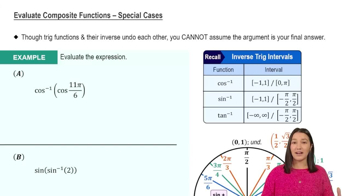
Function Composition

Function composition involves combining two functions, where the output of one function becomes the input of another. For functions f and g, the composition f ○ g means applying g first and then f to the result. Understanding how to correctly apply this process is essential for solving the problem.
Recommended video:
3:48
Evaluate Composite Functions - Special Cases

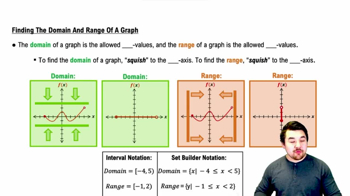
Domain and Range

The domain of a function is the set of all possible input values (x-values) that the function can accept, while the range is the set of all possible output values (y-values) that the function can produce. When composing functions, it is crucial to determine the domain and range of both the individual functions and the composed functions to ensure valid inputs and outputs.
Recommended video:
5:10
Finding the Domain and Range of a Graph

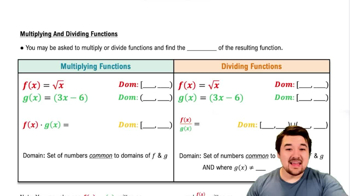
Square Root Function

The square root function, denoted as g(x) = √(x + 2), is defined only for non-negative values of its argument. This means that the expression inside the square root must be greater than or equal to zero. Understanding the restrictions imposed by the square root function is vital for determining the domain of the composed functions.
Recommended video:
7:24
Multiplying & Dividing Functions