Ch. 1 - Functions
Hass - Thomas' Calculus 15th Edition
Hass15th EditionThomas' CalculusISBN: 9780137616077Not the one you use?Change textbook
Chapter 1, Problem 1.3.42

In Exercises 39–42, express the given quantity in terms of sin x and cos x.


cos (3π/2 + x)

Verified step by step guidance
1
Recognize that the expression cos(3π/2 + x) involves a trigonometric identity for cosine of a sum, which is cos(a + b) = cos(a)cos(b) - sin(a)sin(b).
Identify the values of a and b in the expression: here, a = 3π/2 and b = x.
Substitute these values into the identity: cos(3π/2 + x) = cos(3π/2)cos(x) - sin(3π/2)sin(x).
Recall the exact trigonometric values: cos(3π/2) = 0 and sin(3π/2) = -1.
Substitute these values back into the expression: cos(3π/2 + x) = 0 * cos(x) - (-1) * sin(x), which simplifies to sin(x).

Verified video answer for a similar problem:

This video solution was recommended by our tutors as helpful for the problem above.
Video duration:
2m
Was this helpful?

Key Concepts

Here are the essential concepts you must grasp in order to answer the question correctly.

Trigonometric Identities

Trigonometric identities are equations that involve trigonometric functions and are true for all values of the variables involved. They are essential for simplifying expressions and solving equations in trigonometry. Key identities include the Pythagorean identity, angle sum and difference identities, and double angle formulas, which help express trigonometric functions in various forms.
Recommended video:
7:17
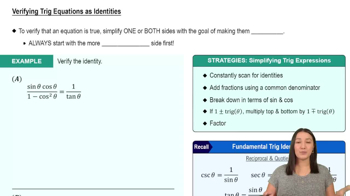
Verifying Trig Equations as Identities

Angle Addition Formulas

Angle addition formulas are specific trigonometric identities that express the sine and cosine of the sum or difference of two angles. For example, the cosine of the sum of two angles is given by cos(a + b) = cos(a)cos(b) - sin(a)sin(b). These formulas are crucial for transforming expressions involving sums of angles into simpler forms using basic trigonometric functions.
Recommended video:
05:56
Additional Rules for Indefinite Integrals

Unit Circle

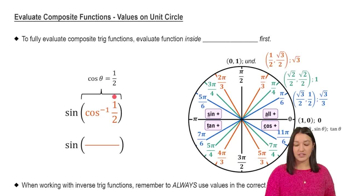
The unit circle is a circle with a radius of one centered at the origin of a coordinate plane. It is a fundamental tool in trigonometry, as it provides a geometric interpretation of the sine and cosine functions. The coordinates of points on the unit circle correspond to the values of cosine and sine for various angles, making it easier to evaluate trigonometric functions for any angle.
Recommended video:
5:10
Evaluate Composite Functions - Values on Unit Circle