Ch. 1 - Functions
Hass - Thomas' Calculus 15th Edition
Hass15th EditionThomas' CalculusISBN: 9780137616077Not the one you use?Change textbook
Chapter 1, Problem 1.P.31

In Exercises 19–32, find the (a) domain and (b) range.


𝔂 = 4 sin ( 1 )
x

Verified step by step guidance
1
Step 1: Identify the function type. The given function is y = 4 sin(1)x, which is a trigonometric function involving sine.
Step 2: Determine the domain of the function. The sine function, sin(x), is defined for all real numbers. Therefore, the domain of y = 4 sin(1)x is all real numbers, which can be expressed as (-∞, ∞).
Step 3: Understand the range of the sine function. The basic sine function, sin(x), has a range of [-1, 1].
Step 4: Consider the effect of the coefficient on the range. The function y = 4 sin(1)x involves a multiplication by 4, which stretches the range of the sine function. Therefore, the range of y = 4 sin(1)x is [-4, 4].
Step 5: Summarize the findings. The domain of the function is all real numbers, and the range is [-4, 4].

Verified video answer for a similar problem:

This video solution was recommended by our tutors as helpful for the problem above.
Video duration:
2m
Was this helpful?

Key Concepts

Here are the essential concepts you must grasp in order to answer the question correctly.

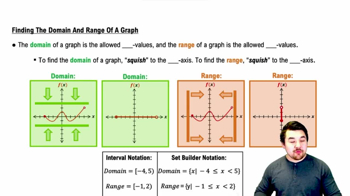
Domain of a Function

The domain of a function refers to the set of all possible input values (x-values) for which the function is defined. For trigonometric functions like sine, the domain is typically all real numbers unless restricted by other factors, such as division by zero or square roots of negative numbers.
Recommended video:
5:10
Finding the Domain and Range of a Graph

Range of a Function

The range of a function is the set of all possible output values (y-values) that the function can produce. For the sine function, the range is limited to values between -1 and 1. When multiplied by a constant, such as 4 in this case, the range adjusts accordingly to between -4 and 4.
Recommended video:
5:10
Finding the Domain and Range of a Graph

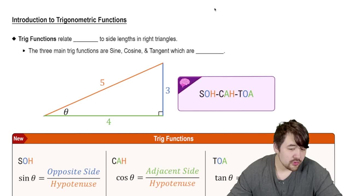
Trigonometric Functions

Trigonometric functions, such as sine, cosine, and tangent, relate angles to ratios of sides in right triangles. The sine function specifically measures the ratio of the length of the opposite side to the hypotenuse. Understanding these functions is crucial for analyzing periodic behavior and determining the domain and range of expressions involving them.
Recommended video:
6:04
Introduction to Trigonometric Functions