
A pen in the shape of an isosceles right triangle with legs of length x ft and hypotenuse of length h ft is to be built. If fencing costs \(5/ft for the legs and \)10/ft for the hypotenuse, write the total cost C of construction as a function of h.
Ch. 1 - Functions
Chapter 1, Problem 1.3.46
Evaluate sin (5π/12).
Verified step by step guidance1
Recognize that \( \frac{5\pi}{12} \) is not a standard angle for which we know the sine value directly. We can express it as a sum or difference of angles for which we know the sine and cosine values.
Express \( \frac{5\pi}{12} \) as a sum of two angles: \( \frac{5\pi}{12} = \frac{\pi}{3} + \frac{\pi}{4} \). Both \( \frac{\pi}{3} \) and \( \frac{\pi}{4} \) are standard angles.
Use the sine addition formula: \( \sin(a + b) = \sin(a)\cos(b) + \cos(a)\sin(b) \). Here, \( a = \frac{\pi}{3} \) and \( b = \frac{\pi}{4} \).
Substitute the known values: \( \sin(\frac{\pi}{3}) = \frac{\sqrt{3}}{2} \), \( \cos(\frac{\pi}{3}) = \frac{1}{2} \), \( \sin(\frac{\pi}{4}) = \frac{\sqrt{2}}{2} \), and \( \cos(\frac{\pi}{4}) = \frac{\sqrt{2}}{2} \).
Calculate \( \sin(\frac{5\pi}{12}) = \sin(\frac{\pi}{3})\cos(\frac{\pi}{4}) + \cos(\frac{\pi}{3})\sin(\frac{\pi}{4}) \) by substituting the values and simplifying the expression.

Verified video answer for a similar problem:
This video solution was recommended by our tutors as helpful for the problem above.
Video duration:
5mWas this helpful?
Key Concepts
Here are the essential concepts you must grasp in order to answer the question correctly.
Trigonometric Functions
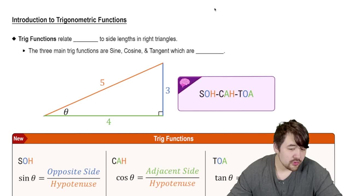
Trigonometric functions, such as sine, cosine, and tangent, relate angles to ratios of sides in right triangles. The sine function specifically measures the ratio of the length of the opposite side to the hypotenuse in a right triangle. Understanding these functions is essential for evaluating angles and solving problems in trigonometry and calculus.
Recommended video:
Introduction to Trigonometric Functions
Angle Addition Formulas
The angle addition formulas allow us to express the sine of a sum of angles in terms of the sines and cosines of the individual angles. For example, sin(a + b) = sin(a)cos(b) + cos(a)sin(b). This concept is particularly useful for evaluating sine at angles that are not standard, such as 5π/12, by breaking it down into known angles.
Recommended video:
Additional Rules for Indefinite Integrals
Unit Circle
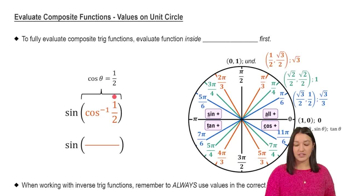
The unit circle is a circle with a radius of one centered at the origin of a coordinate plane. It provides a geometric interpretation of trigonometric functions, where the x-coordinate represents the cosine and the y-coordinate represents the sine of an angle. Understanding the unit circle is crucial for evaluating trigonometric functions at various angles, including those expressed in radians.
Recommended video:
Evaluate Composite Functions - Values on Unit Circle
Related Practice
Textbook Question
Textbook Question
Graphing
In Exercises 69–76, graph each function not by plotting points, but by starting with the graph of one of the standard functions presented in Figures 1.14–1.17 and applying an appropriate transformation.
y = (1/2x) − 1
1
views
Textbook Question
Functions
In Exercises 1–6, find the domain and range of each function.
F(x) = √(5x + 10)
1
views
Textbook Question
Using the Addition Formulas
Use the addition formulas to derive the identities in Exercises 31–36.
sin (x − π/2) = −cos x
Textbook Question
Functions
In Exercises 1–6, find the domain and range of each function.
G(t) = 2/(t² − 16)
1
views
Textbook Question
In Exercises 5–8, determine whether the graph of the function is symmetric about the 𝔂-axis, the origin, or neither.
𝔂 = x² - 2x - 1
1
views
