Express the radius of a sphere as a function of the sphere’s surface area. Then express the surface area as a function of the volume.
Ch. 1 - Functions
Chapter 1, Problem 1.2.12f
Composition of Functions
Let f(x) = x − 3, g(x) = √x, h(x) = x³, and j(x) = 2x. Express each of the functions in Exercises 11 and 12 as a composition involving one or more of f, g, h, and j.
f. y = √(x³ − 3)
Verified step by step guidance1
Identify the innermost function in the expression y = √(x³ − 3). Here, the innermost operation is x³, which corresponds to the function h(x) = x³.
Next, observe that after applying h(x), the expression becomes h(x) = x³. The next operation is subtraction by 3, which corresponds to the function f(x) = x − 3.
Combine these two operations: first apply h(x) to get x³, then apply f(x) to get x³ − 3. This can be expressed as f(h(x)).
Finally, the outermost operation is taking the square root, which corresponds to the function g(x) = √x. Apply g to the result of f(h(x)) to get g(f(h(x))).
Thus, the composition of functions that represents y = √(x³ − 3) is g(f(h(x))).

Verified video answer for a similar problem:
This video solution was recommended by our tutors as helpful for the problem above.
Video duration:
3mWas this helpful?
Key Concepts
Here are the essential concepts you must grasp in order to answer the question correctly.
Composition of Functions
Composition of functions involves combining two or more functions to create a new function. If you have functions f(x) and g(x), the composition is denoted as (f ∘ g)(x) = f(g(x)). This means you apply g first and then apply f to the result. Understanding how to manipulate and combine functions is essential for solving problems that require expressing one function in terms of others.
Recommended video:
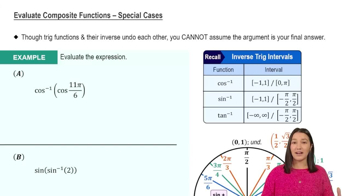
Evaluate Composite Functions - Special Cases
Function Notation
Function notation is a way to represent functions and their outputs. For example, f(x) represents the output of function f when the input is x. This notation is crucial for understanding how to evaluate functions and perform operations like composition. Recognizing how to read and interpret function notation helps in identifying the relationships between different functions.
Recommended video:
Sigma Notation
Algebraic Manipulation
Algebraic manipulation involves rearranging and simplifying expressions to solve equations or express functions in different forms. This skill is vital when working with compositions, as it allows you to substitute and combine functions effectively. Mastery of algebraic techniques, such as factoring, expanding, and simplifying, is necessary to express complex functions in terms of simpler ones.
Recommended video:
Determine Continuity Algebraically
Related Practice
Textbook Question
2
views
Textbook Question
Composition of Functions
Evaluate each expression using the functions
f(x) = 2 − x, g(x) = { −x, −2 ≤ x < 0
x − 1, 0 ≤ x ≤ 2
e. g(f(0))
Textbook Question
Composition of Functions
Evaluate each expression using the functions
f(x) = 2 − x, g(x) = { −x, −2 ≤ x < 0
x − 1, 0 ≤ x ≤ 2
f. f(g(1/2))
1
views
Textbook Question
Combining Functions
Assume that f is an even function, g is an odd function, and both f and g are defined on the entire real line (−∞,∞). Which of the following (where defined) are even? odd?
g. g ∘ f
Textbook Question
Copy and complete the following table of function values. If the function is undefined at a given angle, enter “UND.” Do not use a calculator or tables.
Textbook Question
Composition of Functions
Copy and complete the following table.
d. <IMAGE>