Ch. 1 - Functions
Hass - Thomas' Calculus 15th Edition
Hass15th EditionThomas' CalculusISBN: 9780137616077Not the one you use?Change textbook
Chapter 1, Problem 1.2.14a

Composition of Functions


Copy and complete the following table.


a. <IMAGE>

Verified step by step guidance
1
Step 1: Understand the concept of composition of functions. The composition of two functions f and g, denoted as (f ∘ g)(x), means applying g first and then applying f to the result of g(x).
Step 2: Identify the functions involved in the composition from the table or image provided. Let's assume f(x) and g(x) are given functions.
Step 3: For each x value in the table, calculate g(x) first. This involves substituting the x value into the function g.
Step 4: Use the result from Step 3 as the input for the function f. Substitute g(x) into f to find f(g(x)).
Step 5: Record the result of f(g(x)) for each x value in the table to complete the composition of functions table.

Verified video answer for a similar problem:

This video solution was recommended by our tutors as helpful for the problem above.
Video duration:
1m

Key Concepts

Here are the essential concepts you must grasp in order to answer the question correctly.

Composition of Functions

The composition of functions involves combining two functions to create a new function. If you have two functions, f(x) and g(x), the composition is denoted as (f ∘ g)(x) = f(g(x)). This means you first apply g to x, and then apply f to the result of g. Understanding this concept is crucial for manipulating and evaluating complex functions.
Recommended video:
3:48
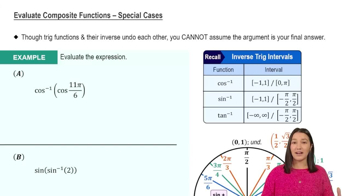
Evaluate Composite Functions - Special Cases

Function Notation

Function notation is a way to represent functions mathematically, typically using symbols like f(x) to denote the output of a function f for a given input x. This notation allows for clear communication of mathematical ideas and operations involving functions, making it easier to work with compositions and transformations of functions.
Recommended video:
Guided course
04:22
Sigma Notation

Evaluating Functions

Evaluating functions involves substituting a specific value into a function to find the corresponding output. For example, if f(x) = 2x + 3, evaluating f(2) would yield 2(2) + 3 = 7. This skill is essential for working with composed functions, as it requires substituting values into multiple functions in sequence.
Recommended video:
Guided course
4:26
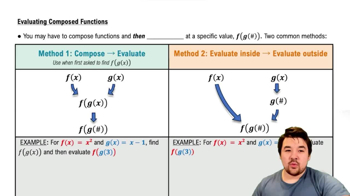
Evaluating Composed Functions