Ch. 1 - Functions
Hass - Thomas' Calculus 15th Edition
Hass15th EditionThomas' CalculusISBN: 9780137616077Not the one you use?Change textbook
Chapter 1, Problem 1.2.2

Algebraic Combinations


In Exercises 1 and 2, find the domains of f, g, f + g, and f ⋅ g.


f(x) = √(x + 1), g(x) = √(x − 1)

Verified step by step guidance
1
Step 1: Determine the domain of f(x) = √(x + 1). The expression inside the square root, x + 1, must be greater than or equal to zero for the square root to be defined. Solve the inequality x + 1 ≥ 0 to find the domain of f(x).
Step 2: Determine the domain of g(x) = √(x − 1). Similarly, the expression inside the square root, x − 1, must be greater than or equal to zero. Solve the inequality x − 1 ≥ 0 to find the domain of g(x).
Step 3: Find the domain of the sum f + g. The domain of f + g is the intersection of the domains of f and g, as both functions must be defined for the sum to be defined.
Step 4: Find the domain of the product f ⋅ g. The domain of f ⋅ g is also the intersection of the domains of f and g, since both functions must be defined for the product to be defined.
Step 5: Combine the results from Steps 1 to 4 to express the domains of f, g, f + g, and f ⋅ g in interval notation.

Verified video answer for a similar problem:

This video solution was recommended by our tutors as helpful for the problem above.
Video duration:
4m
Was this helpful?

Key Concepts

Here are the essential concepts you must grasp in order to answer the question correctly.

Domain of a Function

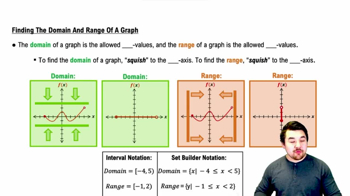
The domain of a function is the set of all possible input values (x-values) for which the function is defined. For functions involving square roots, such as f(x) = √(x + 1) and g(x) = √(x − 1), the expressions under the square roots must be non-negative. This means we need to find the values of x that satisfy these conditions to determine the domain.
Recommended video:
5:10
Finding the Domain and Range of a Graph

Algebraic Combinations of Functions

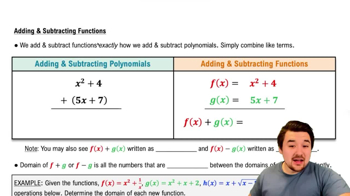
Algebraic combinations of functions involve operations such as addition, subtraction, multiplication, and division applied to two or more functions. In this case, we are looking at f + g and f ⋅ g. The domain of these combinations is determined by the intersection of the individual domains of the functions involved, ensuring that the resulting expressions are defined.
Recommended video:
5:56
Adding & Subtracting Functions

Square Root Function Properties

The square root function has specific properties that affect its domain and range. The output of a square root function is always non-negative, and the input must be greater than or equal to zero. Understanding these properties is crucial for determining the domains of f(x) and g(x), as they dictate the restrictions on x that must be considered when combining these functions.
Recommended video:
06:21
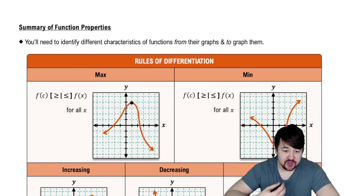
Properties of Functions
Related Practice
Textbook Question

Increasing and Decreasing Functions


Graph the functions in Exercises 37–46. What symmetries, if any, do the graphs have? Specify the intervals over which the function is increasing and the intervals where it is decreasing.


y = −x³

Textbook Question

Use graphing software to graph the functions specified in Exercises 31–36.

Select a viewing window that reveals the key features of the function.


Graph the function f (x) = sin 2x + cos 3x.

1
views
Textbook Question

Increasing and Decreasing Functions


Graph the functions in Exercises 37–46. What symmetries, if any, do the graphs have? Specify the intervals over which the function is increasing and the intervals where it is decreasing.


y = (−x)²/³

1
views
Textbook Question

[Technology Exercise]


a. Graph the functions f(x) = x/2 and g(x) = 1 + (4/x) together to identify the values of x for which


x/2 > 1 + 4/x


b. Confirm your findings in part (a) algebraically.

Textbook Question

Finding a Viewing Window


In Exercises 5–30, find an appropriate graphing software viewing window for the given function and use it to display that function’s graph. The window should give a picture of the overall behavior of the function. There is more than one choice, but incorrect choices can miss important aspects of the function.


y = x + (1/10) sin 30x

Textbook Question

Shifting Graphs


Exercises 27–36 tell how many units and in what directions the graphs of the given equations are to be shifted. Give an equation for the shifted graph. Then sketch the original and shifted graphs together, labeling each graph with its equation.


y = x³ Left 1, down 1