Ch. 1 - Functions
Hass - Thomas' Calculus 15th Edition
Hass15th EditionThomas' CalculusISBN: 9780137616077Not the one you use?Change textbook
Chapter 1, Problem 1.3

A point P in the first quadrant lies on the parabola 𝔂 = 𝔁². Express the coordinates of P as functions of the angle of inclination of the line joining P to the origin.

Verified step by step guidance
1
Start by understanding the problem: We need to express the coordinates of a point P on the parabola y = x² in terms of the angle θ, which is the angle of inclination of the line joining P to the origin.
Recall that the angle of inclination θ of a line with respect to the positive x-axis can be expressed using the tangent function: tan(θ) = y/x. Since P lies on the parabola y = x², substitute y = x² into the tangent expression: tan(θ) = x²/x = x.
From the equation tan(θ) = x, solve for x in terms of θ: x = tan(θ). This gives us the x-coordinate of point P as a function of θ.
Substitute x = tan(θ) back into the parabola equation y = x² to find the y-coordinate: y = (tan(θ))².
Thus, the coordinates of point P can be expressed as functions of θ: P(tan(θ), (tan(θ))²).

Verified video answer for a similar problem:

This video solution was recommended by our tutors as helpful for the problem above.
Video duration:
4m
Was this helpful?

Key Concepts

Here are the essential concepts you must grasp in order to answer the question correctly.

Parabola

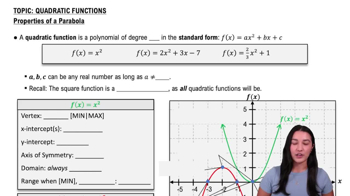
A parabola is a symmetric curve defined by a quadratic equation, such as y = x². In this case, it opens upwards and has its vertex at the origin (0,0). Understanding the properties of parabolas, including their vertex, axis of symmetry, and how points on the curve relate to the equation, is essential for analyzing the position of point P.
Recommended video:
7:42
Properties of Parabolas

Polar Coordinates

Polar coordinates represent points in a plane using a distance from a reference point (the origin) and an angle from a reference direction (usually the positive x-axis). The relationship between Cartesian coordinates (x, y) and polar coordinates (r, θ) is given by x = r cos(θ) and y = r sin(θ). This concept is crucial for expressing the coordinates of point P in terms of the angle of inclination.
Recommended video:
06:10
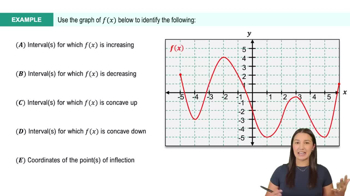
Determining Concavity from the Graph of f' or f'' Example 1

Angle of Inclination

The angle of inclination refers to the angle formed between a line and the positive x-axis. In this context, it describes the direction of the line connecting point P to the origin. Understanding how to relate this angle to the coordinates of point P allows for the expression of P's coordinates as functions of the angle, facilitating the analysis of its position on the parabola.
Recommended video:
8:22
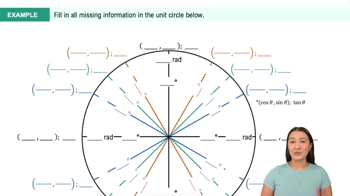
Trig Values in Quadrants II, III, & IV Example 2