
Ch.12 - Parametric and Polar Curves
Briggs - Calculus: Early Transcendentals 3rd Edition
Briggs3rd EditionCalculus: Early TranscendentalsISBN: 9780136847243Not the one you use?Change textbook
Chapter 12, Problem 12.3.81a

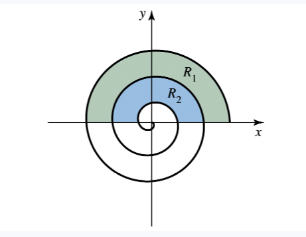
Regions bounded by a spiral: Let Rₙ be the region bounded by the nth turn and the (n+1)st turn of the spiral r = e⁻ᶿ in the first and second quadrants, for θ ≥ 0 (see figure).
a. Find the area Aₙ of Rₙ.


Spiral curve r = e^(-θ) with shaded regions R₁ and R₂ between consecutive turns in the first two quadrants.

Verified step by step guidance
1
Identify the spiral given by the polar equation \(r = e^{-\theta}\), where \(\theta \geq 0\). The regions \(R_n\) are bounded between the \(n\)th and \((n+1)\)st turns of the spiral, which correspond to \(\theta = n\pi\) and \(\theta = (n+1)\pi\) respectively, since one full turn corresponds to an increase of \(\pi\) in \(\theta\) (covering the first and second quadrants).
Recall the formula for the area of a region bounded by a polar curve between angles \(\alpha\) and \(\beta\): \(A = \frac{1}{2} \int_{\alpha}^{\beta} r^2 \, d\theta\)
Apply this formula to find the area \(A_n\) of the region \(R_n\) by integrating \(r^2 = (e^{-\theta})^2 = e^{-2\theta}\) from \(\theta = n\pi\) to \(\theta = (n+1)\pi\): \(A_n = \frac{1}{2} \int_{n\pi}^{(n+1)\pi} e^{-2\theta} \, d\theta\)
Evaluate the integral \(\int e^{-2\theta} \, d\theta\). Use the substitution method or recall that the integral of \(e^{ax}\) is \(\frac{1}{a} e^{ax}\), so here it becomes \(-\frac{1}{2} e^{-2\theta}\) plus a constant of integration.
Substitute the limits \(n\pi\) and \((n+1)\pi\) into the evaluated integral and multiply by \(\frac{1}{2}\) to express \(A_n\) in terms of \(n\). This will give the exact area of the region \(R_n\) bounded by the \(n\)th and \((n+1)\)st turns of the spiral.

Verified video answer for a similar problem:

This video solution was recommended by our tutors as helpful for the problem above.
Video duration:
4m
Was this helpful?

Key Concepts

Here are the essential concepts you must grasp in order to answer the question correctly.

Polar Coordinates and Curves

Polar coordinates represent points using a radius and angle (r, θ), which is essential for describing curves like spirals. The given spiral r = e^(-θ) is defined in terms of θ, making it natural to analyze areas bounded by turns using polar integration.
Recommended video:
05:32
Intro to Polar Coordinates

Area in Polar Coordinates

The area enclosed by a curve in polar coordinates between angles θ = a and θ = b is found using the integral A = 1/2 ∫[a to b] (r(θ))^2 dθ. This formula is crucial for calculating the area of regions bounded by consecutive turns of the spiral.
Recommended video:
05:32
Intro to Polar Coordinates

Understanding Regions Bounded by Spiral Turns

The region Rₙ lies between the nth and (n+1)st turns of the spiral, corresponding to θ values nπ/2 and (n+1)π/2 in the first and second quadrants. Identifying these angular bounds is key to setting up the integral for the area Aₙ.
Recommended video:
04:34
Area of Polar Regions Example 3
Related Practice
Textbook Question

Reflection property of parabolas: Consider the parabola y = x²/(4p) with its focus at F(0, p). The goal is to show that the angle of incidence (α) equals the angle of reflection (β).

a. Let P(x₀, y₀) be a point on the parabola. Show that the slope of the tangent line at P is tan θ = x₀/(2p).

1
views
Textbook Question

Area of a sector of a hyperbola: Consider the region R bounded by the right branch of the hyperbola x²/a² - y²/b² = 1 and the vertical line through the right focus

a. What is the area of R?

Textbook Question

Navigating A plane is 150 miles north of a radar station, and 30 minutes later it is 60 degree east of north at a distance of 100 miles from the radar station. Assume the plane flies on a straight line and maintains constant altitude during this 30-minute period.

a. Find the distance traveled during this 30-minute period.

1
views
Textbook Question

Channel flow Water flows in a shallow semicircular channel with inner and outer radii of 1 m and 2 m (see figure). At a point P(r,θ) in the channel, the flow is in the tangential direction (counterclock wise along circles), and it depends only on r, the distance from the center of the semicircles.


a. Express the region formed by the channel as a set in polar coordinates.

1
views
Textbook Question

Intersecting lines Consider the following pairs of lines. Determine whether the lines are parallel or intersecting. If the lines intersect, then determine the point of intersection.


a. x = 1 + s, y = 2s and x = 1 + 2t, y = 3t

1
views
Textbook Question

67–72. Derivatives Consider the following parametric curves.

a. Determine dy/dx in terms of t and evaluate it at the given value of t.


x = 2 + 4t, y = 4 − 8t; t = 2

1
views