Ch.12 - Parametric and Polar Curves
Briggs - Calculus: Early Transcendentals 3rd Edition
Briggs3rd EditionCalculus: Early TranscendentalsISBN: 9780136847243Not the one you use?Change textbook
Chapter 12, Problem 12.3.76

63–74. Arc length of polar curves Find the length of the following polar curves.


{Use of Tech} The complete limaçon r=4−2cosθ

Verified step by step guidance
1
Recall the formula for the arc length \( L \) of a polar curve \( r = r(\theta) \) from \( \theta = a \) to \( \theta = b \): \[ L = \int_{a}^{b} \sqrt{r(\theta)^2 + \left(\frac{d r}{d \theta}\right)^2} \, d\theta \]
Identify the given polar curve: \( r = 4 - 2 \cos \theta \). We need to find \( \frac{d r}{d \theta} \), the derivative of \( r \) with respect to \( \theta \).
Compute the derivative: \[ \frac{d r}{d \theta} = \frac{d}{d \theta} (4 - 2 \cos \theta) = 2 \sin \theta \]
Determine the interval for \( \theta \) to cover the complete limaçon. Since the limaçon is a closed curve traced once as \( \theta \) goes from \( 0 \) to \( 2\pi \), set the limits of integration as \( a = 0 \) and \( b = 2\pi \).
Set up the integral for the arc length: \[ L = \int_{0}^{2\pi} \sqrt{(4 - 2 \cos \theta)^2 + (2 \sin \theta)^2} \, d\theta \] This integral can then be evaluated (analytically or using technology) to find the length of the limaçon.

Verified video answer for a similar problem:

This video solution was recommended by our tutors as helpful for the problem above.
Video duration:
5m
Was this helpful?

Key Concepts

Here are the essential concepts you must grasp in order to answer the question correctly.

Polar Coordinates and Polar Curves

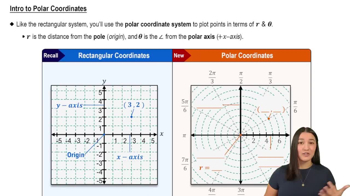
Polar coordinates represent points in the plane using a radius and an angle (r, θ). Polar curves are defined by equations relating r and θ, such as r = 4 - 2cosθ. Understanding how to interpret and plot these curves is essential for analyzing their geometric properties.
Recommended video:
05:32
Intro to Polar Coordinates

Arc Length Formula for Polar Curves

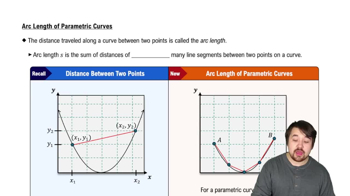
The arc length of a polar curve r(θ) from θ = a to θ = b is given by the integral ∫ₐᵇ √[r(θ)² + (dr/dθ)²] dθ. This formula combines the radius and its rate of change to measure the curve's length accurately. Applying this formula requires computing the derivative dr/dθ and evaluating the integral.
Recommended video:
06:29
Arc Length of Parametric Curves

Use of Technology in Calculus

Technology such as graphing calculators or computer algebra systems can assist in calculating derivatives, evaluating integrals, and visualizing curves. For complex integrals like the arc length of a limaçon, technology helps obtain precise numerical results efficiently.
Recommended video:
06:11
Fundamental Theorem of Calculus Part 1
Related Practice
Textbook Question

57–64. Graphing polar curves Graph the following equations. Use a graphing utility to check your work and produce a final graph.


r² = 4 sin θ  

Textbook Question

Air drop—inverse problem A plane traveling horizontally at 100 m/s over flat ground at an elevation of 4000 m must drop an emergency packet on a target on the ground. The trajectory of the packet is given by

x = 100t, y = −4.9t² + 4000, t ≥ 0

where the origin is the point on the ground directly beneath the plane at the moment of the release. How many horizontal meters before the target should the packet be released in order to hit the target?

1
views
Textbook Question

45–60. Areas of regions Find the area of the following regions.


The region common to the circles r = 2 sin θ and r = 1

Textbook Question

What is the polar equation of a circle of radius √(a²+b²) centered at (a, b)?

1
views
Textbook Question

23–24. Radar Airplanes are equipped with transponders that allow air traffic controllers to see their locations on radar screens. Radar gives the distance of the plane from the radar station (located at the origin) and the angular position of the plane, typically measured in degrees clockwise from north.

A plane is 50 miles from a radar station at an angle of 10 dgeree clockwise from north. Find polar coordinates for the location of the plane.

1
views
Textbook Question

37–52. Curves to parametric equations Find parametric equations for the following curves. Include an interval for the parameter values. Answers are not unique.


The left half of the parabola y=x ² +1, originating at (0, 1)

1
views