Ch.12 - Parametric and Polar Curves
Briggs - Calculus: Early Transcendentals 3rd Edition
Briggs3rd EditionCalculus: Early TranscendentalsISBN: 9780136847243Not the one you use?Change textbook
Chapter 12, Problem 12.4.54

53–56. Eccentricity-directrix approach Find an equation of the following curves, assuming the center is at the origin. Sketch a graph labeling the vertices, foci, asymptotes (if they exist), and directrices. Use a graphing utility to check your work.


An ellipse with vertices (0, ±9) and eccentricity ¼ 

Verified step by step guidance
1
Identify the orientation of the ellipse based on the vertices. Since the vertices are at (0, ±9), the major axis is vertical, so the ellipse is vertical with center at the origin.
Recall the standard form of the ellipse equation with a vertical major axis: \(\frac{x^{2}}{b^{2}} + \frac{y^{2}}{a^{2}} = 1\), where \(a\) is the semi-major axis length and \(b\) is the semi-minor axis length, with \(a > b\).
Determine the value of \(a\) from the vertices. Since the vertices are at (0, ±9), the distance from the center to each vertex is \(a = 9\).
Use the eccentricity formula for an ellipse: \(e = \frac{c}{a}\), where \(c\) is the distance from the center to each focus. Given \(e = \frac{1}{4}\), solve for \(c\) as \(c = e \times a\).
Find \(b\) using the relationship \(c^{2} = a^{2} - b^{2}\). Rearrange to solve for \(b^{2} = a^{2} - c^{2}\). Then write the equation of the ellipse using the values of \(a\) and \(b\).

Verified video answer for a similar problem:

This video solution was recommended by our tutors as helpful for the problem above.
Video duration:
4m
Was this helpful?

Key Concepts

Here are the essential concepts you must grasp in order to answer the question correctly.

Ellipse Definition and Properties

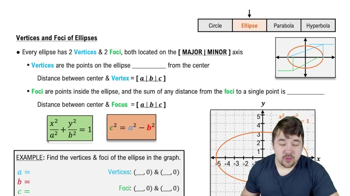
An ellipse is the set of points where the sum of distances to two fixed points (foci) is constant. Key features include vertices, foci, center, and axes lengths. The vertices lie on the major axis, and the distance between the center and vertices defines the semi-major axis length.
Recommended video:
06:21
Properties of Functions

Eccentricity and Directrix of an Ellipse

Eccentricity (e) measures how 'stretched' an ellipse is, defined as the ratio of the distance from a focus to a point on the ellipse over the distance from that point to the corresponding directrix. For ellipses, e is between 0 and 1. The directrix is a fixed line used with eccentricity to define the ellipse geometrically.
Recommended video:
5:30
Foci and Vertices of an Ellipse

Equation of an Ellipse Centered at the Origin

The standard form of an ellipse centered at the origin with vertical major axis is (x²/b²) + (y²/a²) = 1, where a > b. The vertices are at (0, ±a), and the foci at (0, ±c), with c² = a² - b². Using eccentricity e = c/a helps find c and b, enabling the full equation.
Recommended video:
4:50
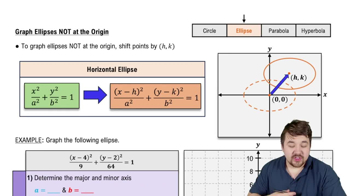
Graph Ellipses NOT at Origin