
Ch.12 - Parametric and Polar Curves
Briggs - Calculus: Early Transcendentals 3rd Edition
Briggs3rd EditionCalculus: Early TranscendentalsISBN: 9780136847243Not the one you use?Change textbook
Chapter 12, Problem 12.3.49

45–60. Areas of regions Find the area of the following regions.


The region inside one leaf of the rose r = cos 5θ

Verified step by step guidance
1
Recognize that the given curve is a rose curve defined by the polar equation \(r = \cos(5\theta)\). This curve has 5 petals because the coefficient of \(\theta\) inside the cosine is 5.
Recall that the area \(A\) enclosed by one petal of a rose curve \(r = \cos(k\theta)\) (where \(k\) is an integer) can be found using the integral formula for polar areas: \(A = \frac{1}{2} \int_{\alpha}^{\beta} r^2 \, d\theta\)
Determine the limits of integration \(\alpha\) and \(\beta\) that correspond to one leaf (one petal) of the rose. Since the rose has 5 petals, one petal corresponds to an interval of \(\frac{2\pi}{5}\) radians. You can find the exact interval by solving \(r = 0\) to find where the petal starts and ends, or use symmetry and set \(\theta\) from \(0\) to \(\frac{\pi}{5}\).
Set up the integral for the area of one petal: \(A = \frac{1}{2} \int_{0}^{\frac{\pi}{5}} \left( \cos(5\theta) \right)^2 \, d\theta\)
Use the trigonometric identity \(\cos^2 x = \frac{1 + \cos(2x)}{2}\) to simplify the integrand before integrating. Then, integrate with respect to \(\theta\) over the chosen limits to find the area of one petal.

Verified video answer for a similar problem:

This video solution was recommended by our tutors as helpful for the problem above.
Video duration:
4m
Was this helpful?

Key Concepts

Here are the essential concepts you must grasp in order to answer the question correctly.

Polar Coordinates and Graphs

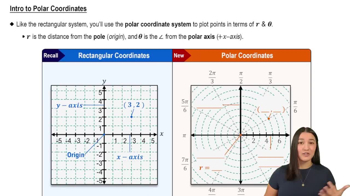
Polar coordinates represent points using a radius and an angle, expressed as (r, θ). Graphs like r = cos 5θ produce rose curves with multiple petals, where the number of petals depends on the coefficient of θ. Understanding how to interpret and sketch these curves is essential for identifying the region whose area is to be found.
Recommended video:
05:32
Intro to Polar Coordinates

Area in Polar Coordinates

The area enclosed by a curve in polar coordinates is found using the integral formula A = (1/2) ∫ r(θ)^2 dθ over the appropriate interval. This formula accounts for the sector-like shape of regions defined by polar functions, making it crucial for calculating areas of petals in rose curves.
Recommended video:
05:32
Intro to Polar Coordinates

Determining Limits of Integration for One Petal

To find the area of one leaf of a rose curve, it is necessary to determine the correct angular interval that traces exactly one petal. For r = cos 5θ, one petal corresponds to an interval of length π/5, derived from the periodicity and symmetry of the function. Setting proper limits ensures the integral covers only the desired region.
Recommended video:
05:50
One-Sided Limits