Ch.12 - Parametric and Polar Curves
Briggs - Calculus: Early Transcendentals 3rd Edition
Briggs3rd EditionCalculus: Early TranscendentalsISBN: 9780136847243Not the one you use?Change textbook
Chapter 12, Problem 12.3.43

41–44. Intersection points and area  Find all the intersection points of the following curves. Find the area of the entire region that lies within both curves


r = 1 + sin θ and r = 1 + cos θ

Verified step by step guidance
1
Identify the curves given in polar coordinates: \( r = 1 + \sin \theta \) and \( r = 1 + \cos \theta \). Our goal is to find their intersection points and the area of the region common to both curves.
To find the intersection points, set the two expressions for \( r \) equal to each other: \( 1 + \sin \theta = 1 + \cos \theta \). Simplify this to \( \sin \theta = \cos \theta \).
Solve the equation \( \sin \theta = \cos \theta \) for \( \theta \). Recall that \( \sin \theta = \cos \theta \) implies \( \tan \theta = 1 \), so \( \theta = \frac{\pi}{4} + k\pi \) for integers \( k \). Determine which of these values lie within the interval \( [0, 2\pi) \) to find all intersection points.
For each intersection angle \( \theta \), substitute back into either curve equation to find the corresponding \( r \) value. This gives the polar coordinates \( (r, \theta) \) of the intersection points.
To find the area of the region common to both curves, set up an integral in polar coordinates. The area inside a polar curve \( r(\theta) \) from \( \alpha \) to \( \beta \) is given by \( \frac{1}{2} \int_{\alpha}^{\beta} r(\theta)^2 \, d\theta \). Determine the intervals where one curve lies inside the other, then integrate the minimum of the two \( r \) values squared over those intervals, and sum these areas to get the total common area.

Verified video answer for a similar problem:

This video solution was recommended by our tutors as helpful for the problem above.
Video duration:
5m
Was this helpful?

Key Concepts

Here are the essential concepts you must grasp in order to answer the question correctly.

Polar Coordinates and Curves

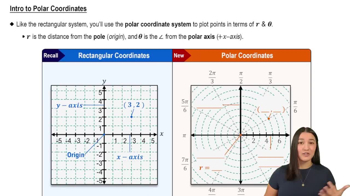
Polar coordinates represent points using a radius and an angle, with curves defined as r(θ). Understanding how to interpret and plot polar equations like r = 1 + sin θ and r = 1 + cos θ is essential for visualizing their shapes and intersection points.
Recommended video:
05:32
Intro to Polar Coordinates

Finding Intersection Points in Polar Coordinates

To find intersection points of two polar curves, set their equations equal (r1 = r2) and solve for θ. This involves solving trigonometric equations and verifying solutions within the domain to identify all points where the curves meet.
Recommended video:
05:32
Intro to Polar Coordinates

Area of Regions Bounded by Polar Curves

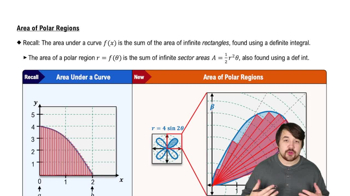
The area enclosed by a polar curve r(θ) between angles α and β is given by (1/2)∫αβ [r(θ)]² dθ. For the region inside both curves, calculate the overlapping area by integrating the minimum radius squared over the appropriate intervals.
Recommended video:
07:45
Area of Polar Regions