
Ch.12 - Parametric and Polar Curves
Briggs - Calculus: Early Transcendentals 3rd Edition
Briggs3rd EditionCalculus: Early TranscendentalsISBN: 9780136847243Not the one you use?Change textbook
Chapter 12, Problem 12.1.33

31–36. Eliminating the parameter Eliminate the parameter to express the following parametric equations as a single equation in x and y.


x=t,y= √(4−t²) a

Verified step by step guidance
1
Start with the given parametric equations: \(x = t\) and \(y = \sqrt{4 - t^2}\).
Since \(x = t\), you can express \(t\) in terms of \(x\) as \(t = x\).
Substitute \(t = x\) into the equation for \(y\): \(y = \sqrt{4 - x^2}\).
To eliminate the square root, square both sides of the equation: \(y^2 = 4 - x^2\).
Rearrange the equation to express it in terms of \(x\) and \(y\): \(x^2 + y^2 = 4\).

Verified video answer for a similar problem:

This video solution was recommended by our tutors as helpful for the problem above.
Video duration:
1m
Was this helpful?

Key Concepts

Here are the essential concepts you must grasp in order to answer the question correctly.

Parametric Equations

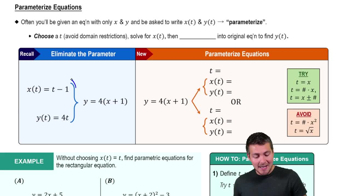
Parametric equations express the coordinates of points on a curve as functions of a parameter, usually denoted as t. Instead of y as a function of x, both x and y depend on t, allowing the description of more complex curves.
Recommended video:
Guided course
08:02
Parameterizing Equations

Eliminating the Parameter

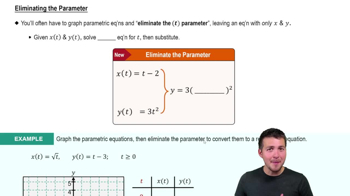
Eliminating the parameter involves rewriting the parametric equations to remove the parameter t, resulting in a single equation relating x and y directly. This often requires solving one equation for t and substituting into the other.
Recommended video:
Guided course
05:59
Eliminating the Parameter

Using Algebraic Manipulation and Identities

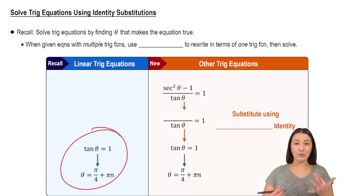
To eliminate the parameter, algebraic techniques such as isolating variables, squaring both sides, or applying identities (like Pythagorean identities) are used. These steps help transform parametric forms into standard Cartesian equations.
Recommended video:
4:42
Solve Trig Equations Using Identity Substitutions