Ch.12 - Parametric and Polar Curves
Briggs - Calculus: Early Transcendentals 3rd Edition
Briggs3rd EditionCalculus: Early TranscendentalsISBN: 9780136847243Not the one you use?Change textbook
Chapter 12, Problem 12.3.25

25–28. Horizontal and vertical tangents Find the points at which the following polar curves have horizontal or vertical tangent lines.
r = 4 cos θ

Verified step by step guidance
1
Recall that for a polar curve given by \(r = f(\theta)\), the Cartesian coordinates are \(x = r \cos \theta\) and \(y = r \sin \theta\).
To find the slope of the tangent line, compute \(\frac{dy}{dx} = \frac{\frac{dy}{d\theta}}{\frac{dx}{d\theta}}\). This requires finding \(\frac{dx}{d\theta}\) and \(\frac{dy}{d\theta}\) using the product and chain rules.
Calculate \(\frac{dx}{d\theta} = \frac{d}{d\theta} (r \cos \theta) = \frac{dr}{d\theta} \cos \theta - r \sin \theta\) and \(\frac{dy}{d\theta} = \frac{d}{d\theta} (r \sin \theta) = \frac{dr}{d\theta} \sin \theta + r \cos \theta\).
Find \(\frac{dr}{d\theta}\) by differentiating \(r = 4 \cos \theta\), so \(\frac{dr}{d\theta} = -4 \sin \theta\).
Set the numerator of \(\frac{dy}{dx}\) equal to zero to find horizontal tangents (where \(\frac{dy}{d\theta} = 0\) and \(\frac{dx}{d\theta} \neq 0\)), and set the denominator equal to zero to find vertical tangents (where \(\frac{dx}{d\theta} = 0\) and \(\frac{dy}{d\theta} \neq 0\)). Solve these equations for \(\theta\) and then find the corresponding points \((r, \theta)\).

Verified video answer for a similar problem:

This video solution was recommended by our tutors as helpful for the problem above.
Video duration:
9m
Was this helpful?

Key Concepts

Here are the essential concepts you must grasp in order to answer the question correctly.

Polar Coordinates and Polar Curves

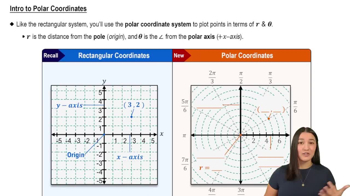
Polar coordinates represent points using a radius and an angle (r, θ) instead of Cartesian coordinates (x, y). Polar curves are equations expressed in terms of r and θ, describing shapes based on the distance from the origin and the angle. Understanding how to interpret and plot these curves is essential for analyzing their properties.
Recommended video:
05:32
Intro to Polar Coordinates

Derivatives of Polar Curves and Tangent Lines

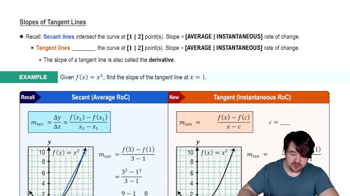
To find tangent lines to polar curves, we convert the polar equation to parametric form (x = r cos θ, y = r sin θ) and compute dy/dx using derivatives with respect to θ. The slope of the tangent line is given by (dy/dθ) / (dx/dθ). This derivative helps identify where the tangent is horizontal or vertical.
Recommended video:
05:13
Slopes of Tangent Lines

Conditions for Horizontal and Vertical Tangents

A horizontal tangent occurs where the slope dy/dx = 0, meaning dy/dθ = 0 while dx/dθ ≠ 0. A vertical tangent occurs where the slope is undefined, meaning dx/dθ = 0 while dy/dθ ≠ 0. Applying these conditions to the derivatives of the polar curve reveals the points with horizontal or vertical tangents.
Recommended video:
5:28
Horizontal Parabolas