
Ch. 9 - Differential Equations
Briggs - Calculus: Early Transcendentals 3rd Edition
Briggs3rd EditionCalculus: Early TranscendentalsISBN: 9780136847243Not the one you use?Change textbook
Chapter 9, Problem 9.3.40a

{Use of Tech} Logistic equation for an epidemic When an infected person is introduced into a closed and otherwise healthy community, the number of people who contract the disease (in the absence of any intervention) may be modeled by the logistic equation
dP/dt=kP(1−P/A),P0=P_0,
where K is a positive infection rate, A is the number of people in the community, and P0 is the number of infected people at t=0. The model also assumes no recovery.
a. Find the solution of the initial value problem, for t≥0, in terms of K, A, and P0.

Verified step by step guidance
1
Recognize that the given differential equation is a logistic differential equation of the form \(\frac{dP}{dt} = kP\left(1 - \frac{P}{A}\right)\), where \(k\) and \(A\) are constants, and \(P(t)\) is the function to solve for with initial condition \(P(0) = P_0\).
Rewrite the equation to separate variables: \(\frac{dP}{P(1 - \frac{P}{A})} = k \, dt\). This allows us to integrate both sides with respect to their variables.
Simplify the left side by expressing the denominator as \(P\left(1 - \frac{P}{A}\right) = P \left(\frac{A - P}{A}\right) = \frac{P(A - P)}{A}\). Then, rewrite the integral as \(\int \frac{A}{P(A - P)} \, dP = \int k \, dt\).
Use partial fraction decomposition to break down \(\frac{A}{P(A - P)}\) into simpler fractions: \(\frac{A}{P(A - P)} = \frac{C}{P} + \frac{D}{A - P}\). Find constants \(C\) and \(D\) by equating numerators.
Integrate both sides: \(\int \left(\frac{C}{P} + \frac{D}{A - P}\right) dP = \int k \, dt\). After integration, solve for \(P(t)\) explicitly, applying the initial condition \(P(0) = P_0\) to find the constant of integration.

Verified video answer for a similar problem:

This video solution was recommended by our tutors as helpful for the problem above.
Video duration:
8m
Was this helpful?

Key Concepts

Here are the essential concepts you must grasp in order to answer the question correctly.

Logistic Differential Equation

The logistic differential equation models population growth with a carrying capacity, expressed as dP/dt = kP(1 - P/A). Here, P(t) is the population at time t, k is the growth rate, and A is the maximum population limit. It captures initial exponential growth that slows as P approaches A.
Recommended video:
07:39
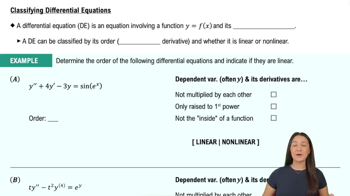
Classifying Differential Equations

Initial Value Problem (IVP)

An initial value problem involves solving a differential equation with a given initial condition, such as P(0) = P0. This condition allows determination of the specific solution curve that fits the starting state of the system, ensuring a unique solution.
Recommended video:
05:03
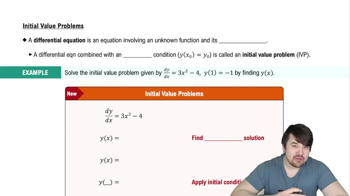
Initial Value Problems

Separation of Variables Method

Separation of variables is a technique to solve differential equations by rewriting them so that all terms involving P are on one side and all terms involving t on the other. Integrating both sides then yields an implicit or explicit solution for P(t).
Recommended video:
07:15
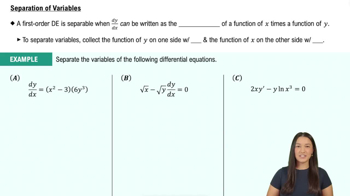
Separation of Variables
Related Practice
Textbook Question

{Use of Tech} Logistic equation for spread of rumors Sociologists model the spread of rumors using logistic equations. The key assumption is that at any given time, a fraction y of the population, where 0≤y≤1, knows the rumor, while the remaining fraction 1−y does not. Furthermore, the rumor spreads by interactions between those who know the rumor and those who do not. The number of such interactions is proportional to y1−y. Therefore, the equation that describes the spread of the rumor is y′(t)=ky(1−y), for t≥0 where k is a positive real number and t is measured in weeks. The number of people who initially know the rumor is y(0)=y0, where 0≤y0≤1. 

a. Solve this initial value problem and give the solution in terms of k and y0.

1
views
Textbook Question

{Use of Tech} Analytical solution of the predator-prey equations The solution of the predator-prey equations

X'(t) = -ax + bxy,y’(t) = cy - dxy

can be viewed as parametric equations that describe the solution curves. Assume a, b, c, and d are positive constants and consider solutions in the first quadrant.


a. Recalling that dy/dx = y(t)/x′(t), divide the first equation by the second equation to obtain a separable differential equation in terms of x and y.

1
views
Textbook Question

U.S. population projections According to the U.S. Census Bureau, the nation’s population (to the nearest million) was 296 million in 2005 and 321 million in 2015. The Bureau also projects a 2050 population of 398 million. To construct a logistic model, both the growth rate and the carrying capacity must be estimated. There are several ways to estimate these parameters. Here is one approach:


a. Assume t = 0 corresponds to 2005 and that the population growth is exponential for the first ten years; that is, between 2005 and 2015, the population is given by P(t) = P(0)exp(rt). Estimate the growth rate r using this assumption.

Textbook Question

A physiological model A common assumption in modeling drug assimilation is that the blood volume in a person is a single compartment that behaves like a stirred tank. Suppose the blood volume is a four-liter tank that initially has a zero concentration of a particular drug. At time t = 0, an intravenous line is inserted into a vein (into the tank) that carries a drug solution with a concentration of 500 mg/L. The inflow rate is 0.06 L/min. Assume the drug is quickly mixed thoroughly in the blood and that the volume of blood remains constant.

a. Write an initial value problem that models the mass of the drug in the blood, for t ≥ 0.

1
views
Textbook Question

23–26. Stirred tank reactions For each of the following stirred tank reactions, carry out the following analysis.

a. Write an initial value problem for the mass of the substance.


A 500-L tank is initially filled with pure water. A copper sulfate solution with a concentration of 20 g/L flows into the tank at a rate of 4 L/min. The thoroughly mixed solution is drained from the tank at a rate of 4 L/min.

Textbook Question

Solving Bernoulli equations Use the method outlined in Exercise 43 to solve the following Bernoulli equations.


a. y′(t) + y = 2y²

1
views