Ch. 9 - Differential Equations
Briggs - Calculus: Early Transcendentals 3rd Edition
Briggs3rd EditionCalculus: Early TranscendentalsISBN: 9780136847243Not the one you use?Change textbook
Chapter 9, Problem 9.5.31b

Explain why or why not Determine whether the following statements are true and give an explanation or counterexample.


b. The solution of a stirred tank initial value problem always approaches a constant as t→∞

Verified step by step guidance
1
Step 1: Understand the problem context. A stirred tank initial value problem typically models the concentration or temperature in a tank over time, often described by a differential equation with an initial condition.
Step 2: Recall that the long-term behavior of solutions to differential equations depends on the nature of the equation, especially whether it has stable equilibrium points.
Step 3: Consider that if the system has a stable equilibrium (a constant solution where the derivative is zero), then solutions starting near that equilibrium will approach it as \(t \to \infty\).
Step 4: However, if the system is non-autonomous, or if the equilibrium is unstable or does not exist, the solution may not approach a constant; it could oscillate, grow without bound, or behave otherwise.
Step 5: Therefore, to determine if the solution always approaches a constant, analyze the specific differential equation governing the stirred tank problem, check for equilibrium points and their stability, and provide a counterexample if such conditions are not met.

Verified video answer for a similar problem:

This video solution was recommended by our tutors as helpful for the problem above.
Video duration:
3m
Was this helpful?

Key Concepts

Here are the essential concepts you must grasp in order to answer the question correctly.

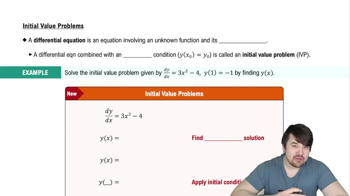
Initial Value Problems (IVPs)

An initial value problem involves solving a differential equation with a given starting condition. The solution describes how a system evolves over time from that initial state, and understanding IVPs is essential to analyze the behavior of solutions as time progresses.
Recommended video:
05:03
Initial Value Problems

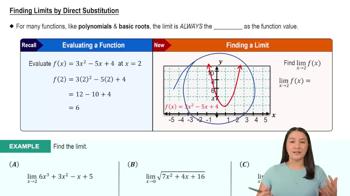
Long-term Behavior and Stability of Solutions

This concept examines whether solutions to differential equations approach a steady state, oscillate, or diverge as time goes to infinity. Stability analysis helps determine if solutions settle to constants or exhibit other behaviors, which is crucial for assessing the statement about the solution approaching a constant.
Recommended video:
05:21
Finding Limits by Direct Substitution

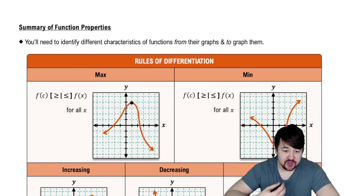
Properties of Stirred Tank Models

Stirred tank problems often model mixing processes using differential equations that may have equilibrium points. Understanding the physical setup and mathematical formulation helps predict if the concentration or state variables stabilize or not, informing whether the solution approaches a constant as time increases.
Recommended video:
06:21
Properties of Functions
Related Practice
Textbook Question

Explain why or why not Determine whether the following statements are true and give an explanation or counterexample.

b. Euler’s method is used to compute exact values of the solution of an initial value problem. 

Textbook Question

Blowup in finite time Consider the initial value problem y'(t) = yⁿ + 1, y(0) = y₀, where n is a positive integer.

b. Solve the initial value problem with n = 2 and y₀ = 1/√2.

1
views
Textbook Question

38–43. Equilibrium solutions A differential equation of the form y′(t)=f(y) is said to be autonomous (the function f depends only on y). The constant function y=y0 is an equilibrium solution of the equation provided f(y0)=0 (because then y'(t)=0 and the solution remains constant for all t). Note that equilibrium solutions correspond to horizontal lines in the direction field. Note also that for autonomous equations, the direction field is independent of t. Carry out the following analysis on the given equations.

b. Sketch the direction field, for t≥0.


y′(t) = 2y + 4

Textbook Question

{Use of Tech} Tumor growth The Gompertz growth equation is often used to model the growth of tumors. Let M(t) be the mass of a tumor at time t≥0. The relevant initial value problem is 

dM/dt=−rM ln(M/K),M(0)=M0, 

where r and K are positive constants and 0<M0<K.

b. Solve the initial value problem and graph the solution for r=1,K=4, and M0=1. Describe the growth pattern of the tumor. Is the growth unbounded? If not, what is the limiting size of the tumor? 

Textbook Question

27–30. Predator-prey models Consider the following pairs of differential equations that model a predator-prey system with populations x and y. In each case, carry out the following steps.

b. Find the lines along which x'(t) = 0. Find the lines along which y'(t) = 0.


x′(t) = 2x − xy, y′(t) = −y + xy

1
views
Textbook Question

29–32. {Use of Tech} Errors in Euler’s method Consider the following initial value problems.


b. Using the exact solution given, compute the errors in the Euler approximations at t=0.2 and t=0.4.


y′(t) = 2t + 1, y(0) = 0; y(t) = t² + t

1
views