
Ch. 9 - Differential Equations
Briggs - Calculus: Early Transcendentals 3rd Edition
Briggs3rd EditionCalculus: Early TranscendentalsISBN: 9780136847243Not the one you use?Change textbook
Chapter 9, Problem 9.4.35d

Explain why or why not Determine whether the following statements are true and give an explanation or counterexample


d. According to Newton’s Law of Cooling, the temperature of a hot object will reach the ambient temperature after a finite amount of time.

Verified step by step guidance
1
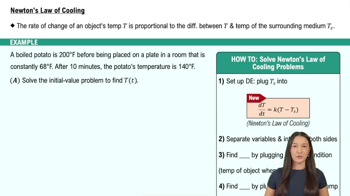
Recall Newton's Law of Cooling, which states that the rate of change of the temperature \(T(t)\) of an object is proportional to the difference between its temperature and the ambient temperature \(T_a\(. Mathematically, this is expressed as: \[\frac{dT}{dt} = -k (T - T_a)\] where \)k > 0\) is a constant depending on the characteristics of the object and environment.
Solve this first-order differential equation by separating variables or recognizing it as a linear ODE. The general solution is: \[T(t) = T_a + (T_0 - T_a) e^{-k t}\] where \(T_0\) is the initial temperature of the object at time \(t=0\).
Analyze the behavior of \(T(t)\) as \(t \to \infty\). Since \(e^{-k t}\) approaches zero as \(t\) becomes very large, the temperature \(T(t)\) approaches the ambient temperature \(T_a\) asymptotically.
Understand the meaning of "reaching" the ambient temperature. Because the exponential term never becomes exactly zero for any finite \(t\), the temperature \(T(t)\) never equals \(T_a\) at any finite time, but only approaches it infinitely closely as time goes to infinity.
Conclude that according to Newton's Law of Cooling, the temperature of a hot object does not reach the ambient temperature after a finite amount of time, but rather approaches it asymptotically. Therefore, the statement is false.

Verified video answer for a similar problem:

This video solution was recommended by our tutors as helpful for the problem above.
Video duration:
3m
Was this helpful?

Key Concepts

Here are the essential concepts you must grasp in order to answer the question correctly.

Newton's Law of Cooling

Newton's Law of Cooling states that the rate of change of an object's temperature is proportional to the difference between its temperature and the ambient temperature. This results in an exponential decay of the temperature difference over time, describing how objects cool or warm toward the surrounding temperature.
Recommended video:
10:44
Newton's Law of Cooling

Exponential Decay and Limits

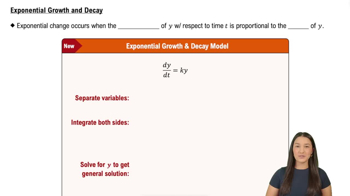
Exponential decay functions approach a limiting value asymptotically, meaning they get closer and closer to a certain temperature but never actually reach it in finite time. This concept explains why the temperature difference decreases continuously but does not become zero at any finite moment.
Recommended video:
09:29
Exponential Growth & Decay

Finite Time vs. Infinite Time in Cooling Processes

In cooling processes governed by Newton's Law, the temperature difference approaches zero only as time approaches infinity. Therefore, the object never exactly reaches ambient temperature in finite time, highlighting the difference between practical approximation and mathematical exactness.
Recommended video:
05:59
Estimating the Area Under a Curve with Right Endpoints & Midpoint
Related Practice
Textbook Question

27–30. Predator-prey models Consider the following pairs of differential equations that model a predator-prey system with populations x and y. In each case, carry out the following steps.


e. Sketch a representative solution curve in the xy-plane and indicate the direction in which the solution evolves.


x′(t) = −3x + 6xy, y′(t) = y − 4xy

Textbook Question

U.S. population projections According to the U.S. Census Bureau, the nation’s population (to the nearest million) was 296 million in 2005 and 321 million in 2015. The Bureau also projects a 2050 population of 398 million. To construct a logistic model, both the growth rate and the carrying capacity must be estimated. There are several ways to estimate these parameters. Here is one approach:


d. Estimations of this kind must be made and interpreted carefully. Suppose the projected population for 2050 is 410 million rather than 398 million. What is the value of the carrying capacity in this case?

Textbook Question

A physiological model A common assumption in modeling drug assimilation is that the blood volume in a person is a single compartment that behaves like a stirred tank. Suppose the blood volume is a four-liter tank that initially has a zero concentration of a particular drug. At time t = 0, an intravenous line is inserted into a vein (into the tank) that carries a drug solution with a concentration of 500 mg/L. The inflow rate is 0.06 L/min. Assume the drug is quickly mixed thoroughly in the blood and that the volume of blood remains constant.

d. After how many minutes does the drug mass reach 90% of its steady-state level? 

Textbook Question

33–36. {Use of Tech} Computing Euler approximations Use a calculator or computer program to carry out the following steps.

d. Compare the errors in the approximations to y(T).


y′(t) = 6 - 2y, y(0) = -1; Δt = 0.2, T = 3; y(t) = 3 - 4e⁻²ᵗ

1
views
Textbook Question

27–30. Predator-prey models Consider the following pairs of differential equations that model a predator-prey system with populations x and y. In each case, carry out the following steps.

d. Identify the four regions in the first quadrant of the xy-plane in which x' and y' are positive or negative.


x′(t) = 2x − 4xy, y′(t) = −y + 2xy

Textbook Question

17–20. Increasing and decreasing solutions Consider the following differential equations. A detailed direction field is not needed.


d. Sketch the direction field and verify that it is consistent with parts (a)–(c).


y'(t) = (y−2)(y+1)