Ch. 9 - Differential Equations
Briggs - Calculus: Early Transcendentals 3rd Edition
Briggs3rd EditionCalculus: Early TranscendentalsISBN: 9780136847243Not the one you use?Change textbook
Chapter 9, Problem 9.4.36

Case 2 of the general solution Solve the equation y′(t) = ky + b in the case that ky + b < 0 and verify that the general solution is y(t) = Ceᵏᵗ − b/k.

Verified step by step guidance
1
Recognize that the given differential equation is a first-order linear ordinary differential equation of the form \(y'(t) = ky + b\), where \(k\) and \(b\) are constants.
Rewrite the equation as \(y'(t) - ky = b\) to identify it in the standard linear form \(y' + p(t)y = q(t)\), where \(p(t) = -k\) and \(q(t) = b\).
Find the integrating factor \(\mu(t)\), which is given by \(\mu(t) = e^{\int -k \, dt} = e^{-kt}\).
Multiply both sides of the differential equation by the integrating factor to get \(e^{-kt} y'(t) - k e^{-kt} y = b e^{-kt}\), which simplifies to \(\frac{d}{dt} \left( e^{-kt} y \right) = b e^{-kt}\).
Integrate both sides with respect to \(t\): \(\int \frac{d}{dt} \left( e^{-kt} y \right) dt = \int b e^{-kt} dt\), then solve for \(y(t)\) to find the general solution in the form \(y(t) = C e^{kt} - \frac{b}{k}\), where \(C\) is the constant of integration.

Verified video answer for a similar problem:

This video solution was recommended by our tutors as helpful for the problem above.
Video duration:
1m
Was this helpful?

Key Concepts

Here are the essential concepts you must grasp in order to answer the question correctly.

First-Order Linear Differential Equations

These are differential equations of the form y' = ky + b, where k and b are constants. They describe rates of change proportional to the function itself plus a constant term. Understanding their structure is essential for finding general solutions.
Recommended video:
07:39
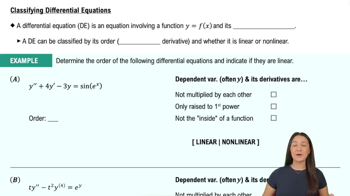
Classifying Differential Equations

General Solution of Non-Homogeneous Equations

The general solution combines the homogeneous solution (y' = ky) and a particular solution to the non-homogeneous equation (y' = ky + b). This approach ensures all possible solutions are captured, typically expressed as y(t) = Ce^{kt} plus a constant term.
Recommended video:
04:00
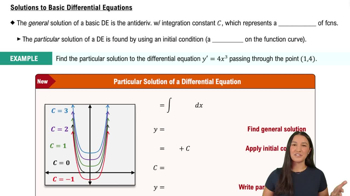
Solutions to Basic Differential Equations

Verification by Substitution

To verify a proposed solution, substitute it back into the original differential equation. This confirms whether the solution satisfies the equation for all t, ensuring correctness and understanding of the solution's behavior.
Recommended video:
04:27
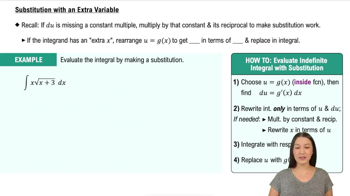
Substitution With an Extra Variable